Technische Universität Braunschweig
  • Studium & Lehre
    • Vor dem Studium
      • Informationen für Studieninteressierte
      • Studiengänge von A-Z
      • Bewerbung
      • Fit4TU - Self-Assessment
      • Beratungsangebote für Studieninteressierte
      • Warum Braunschweig?
    • Im Studium
      • Erstsemester-Hub
      • Semestertermine
      • Lehrveranstaltungen
      • Studien-ABC
      • Studienorganisation
      • Beratungsnavi
      • Zusatzqualifikationen
      • Finanzierung und Kosten
      • Besondere Studienbedingungen
      • Gesundheit & Wohlbefinden
      • Campusleben
    • Nach dem Studium
      • Exmatrikulation und Vorlegalisation
      • Nach dem Abschluss
      • Alumni*ae
    • Strategien und Qualitätsmanagement
      • Strategiepapiere für Studium und Lehre
      • Studienqualitätsmittel
      • Studiengangsentwicklung
      • Qualitätsmanagement
      • Systemakkreditierung
      • Rechtliche Grundlagen
      • TU Lehrpreis
    • Für Lehrende
      • Informationen für Lehrende
      • Konzepte
      • Lernmanagementsystem Stud.IP
    • Kontakt
      • Studienservice-Center
      • Sag's uns - in Studium und Lehre
      • Zentrale Studienberatung
      • Immatrikulationsamt
      • Abteilung 16 - Studium und Lehre
      • Career Service
      • Projekthaus
  • Forschung
    • Forschungsprofil
      • Forschungsschwerpunkte
      • Exzellenzcluster der TU Braunschweig
      • Forschungsprojekte
      • Forschungszentren
      • Forschungsprofile der Professuren
    • Frühe Karrierephase
      • Förderung in den frühen Phasen der wissenschaftlichen Karriere
      • Promotion
      • Postdocs
      • Nachwuchsgruppenleitung
      • Junior Professur und Tenure-Track
      • Habilitation
      • Service-Angebote für Wissenschaftler*innen
    • Forschungsdaten & Transparenz
      • Transparenz in der Forschung
      • Forschungsdaten
      • Open Access Strategie
      • Digitale Forschungsanzeige
    • Forschungsförderung
      • Netzwerk Forschungsförderung
      • Datenbanken und Stiftungen
    • Kontakt
      • Forschungsservice
      • Graduiertenakademie
  • International
    • Internationale Studierende
      • Warum Braunschweig?
      • Studium mit Abschluss
      • Austauschstudium
      • TU Braunschweig Summer School
      • Geflüchtete
      • International Student Support
    • Wege ins Ausland
      • Studium im Ausland
      • Praktikum im Ausland
      • Lehren und Forschen im Ausland
      • Arbeiten im Ausland
    • Internationale Forschende
      • Welcome Support
      • Promotionsstudium
      • Service für gastgebende Einrichtungen
    • Sprachen und interkulturelle Kompetenzvermittlung
      • Deutsch lernen
      • Fremdsprachen lernen
      • Interkulturelle Kompetenzvermittlung
    • Internationales Profil
      • Internationalisierung
      • Internationale Kooperationen
      • Strategische Partnerschaften
      • Internationale Netzwerke
    • International House
      • Wir über uns
      • Kontakt & Sprechstunden
      • Aktuelles und Termine
      • International Days
      • 5. Studentische Konferenz: Internationalisierung der Hochschulen
      • Newsletter, Podcast & Videos
      • Stellenausschreibungen
  • Die TU Braunschweig
    • Unser Profil
      • Ziele & Werte
      • Ordnungen und Leitlinien
      • Allianzen & Partner
      • Hochschulentwicklung 2030
      • Stiftungsuniversität
      • Internationale Strategie
      • Fakten & Zahlen
      • Unsere Geschichte
    • Karriere
      • Arbeiten an der TU
      • Stellenmarkt
      • Berufsausbildung an der TU
    • Wirtschaft & Unternehmen
      • Unternehmensgründung
      • Freunde & Förderer
    • Öffentlichkeit
      • Veranstaltungskalender
      • Check-in für Schüler*innen
      • Hochschulinformationstag (HIT)
      • Kinder-Uni
      • Das Studierendenhaus
      • Gasthörer*innen & Senior*innenstudium
      • Nutzung der Universitätsbibliothek
    • Presse & Kommunikation
      • Stabsstelle Presse und Kommunikation
      • Medienservice
      • Ansprechpartner*innen
      • Tipps für Wissenschaftler*innen
      • Themen und Stories
    • Kontakt
      • Allgemeiner Kontakt
      • Anreise
      • Für Hinweisgeber
  • Struktur
    • Leitung & Verwaltung
      • Das Präsidium
      • Stabsstellen
      • Verwaltung
      • Organe, Statusgruppen und Kommissionen
    • Fakultäten
      • Carl-Friedrich-Gauß-Fakultät
      • Fakultät für Lebenswissenschaften
      • Fakultät Architektur, Bauingenieurwesen und Umweltwissenschaften
      • Fakultät für Maschinenbau
      • Fakultät für Elektrotechnik, Informationstechnik, Physik
      • Fakultät für Geistes- und Erziehungswissenschaften
    • Institute
      • Institute von A-Z
    • Einrichtungen
      • Universitätsbibliothek
      • Gauß-IT-Zentrum
      • Zentrale Personalentwicklung
      • International House
      • Projekthaus
      • Transferservice
      • Hochschulsportzentrum
      • Einrichtungen von A-Z
    • Studierendenschaft
      • Studierendenparlament
      • Fachschaften
      • Studentische Wahlen
    • Lehrer*innenbildung
      • Lehrer*innenfortbildung
      • Forschung
    • Chancengleichheit
      • Gleichstellung
      • Familie
      • Diversität
    • Kontakt
      • Personensuche
  • Suche
  • Schnellzugriff
    • Personensuche
    • Webmail
    • cloud.TU Braunschweig
    • Messenger
    • Mensa
    • TUconnect (Studierendenportal)
    • Lehrveranstaltungen
    • Im Notfall
    • Stud.IP
    • UB Katalog
    • Status GITZ-Dienste
    • Störungsmeldung GB3
    • IT Dienste
    • Informationsportal (Beschäftigte)
    • Beratungsnavi
    • Linksammlung
    • DE
    • EN
    • IBR YouTube
    • Facebook
    • Instagram
    • YouTube
    • LinkedIn
    • Mastodon
Menü
  • Struktur
  • Fakultäten
  • Carl-Friedrich-Gauß-Fakultät
  • Institute
  • Institut für Betriebssysteme und Rechnerverbund
  • Aktuelle Projekte
  • libsmi
  • libsmi: Diagramme
Logo IBR
IBR Login
  • Institut für Betriebssysteme und Rechnerverbund
    • News
    • Wir über uns
      • Gesamtes Team
      • Anreise
      • Raumplan
      • Projekte
      • Veröffentlichungen
      • Software
      • News Archiv
    • Connected and Mobile Systems
      • Team
      • Lehrveranstaltungen
      • Abschlussarbeiten
      • Projekte
      • Veröffentlichungen
      • Software
      • Datensätze
    • Verlässliche Systemsoftware
      • Übersicht
      • Team
      • Lehre
      • Arbeiten & Jobs
      • Forschung
      • Publikationen
    • Algorithmik
      • Team
      • Lehrveranstaltungen
      • Abschlussarbeiten
      • Projekte
      • Veröffentlichungen
    • Mikroprozessorlabor
    • Studium
      • Wintersemester 2026/2027
      • Sommersemester 2026
      • Abschlussarbeiten
    • Service
      • Bibliothek
      • Mailinglisten
      • Webmail
      • Knowledgebase
      • Wiki
      • Account Management
      • Service-Status
    • Spin-Offs
      • Docoloc
      • bliq (formerly AIPARK)
      • Confidential Technologies
    • Forschungsverbünde
      • IST.hub

MIB diagrams

smidump draws UML class diagrams of MIB modules as SVG. They show the conceptual model behind the tables of a module and how the tables relate to each other. Create them for any module with the web tools, e.g. for the ENTITY-MIB, or on the command line.
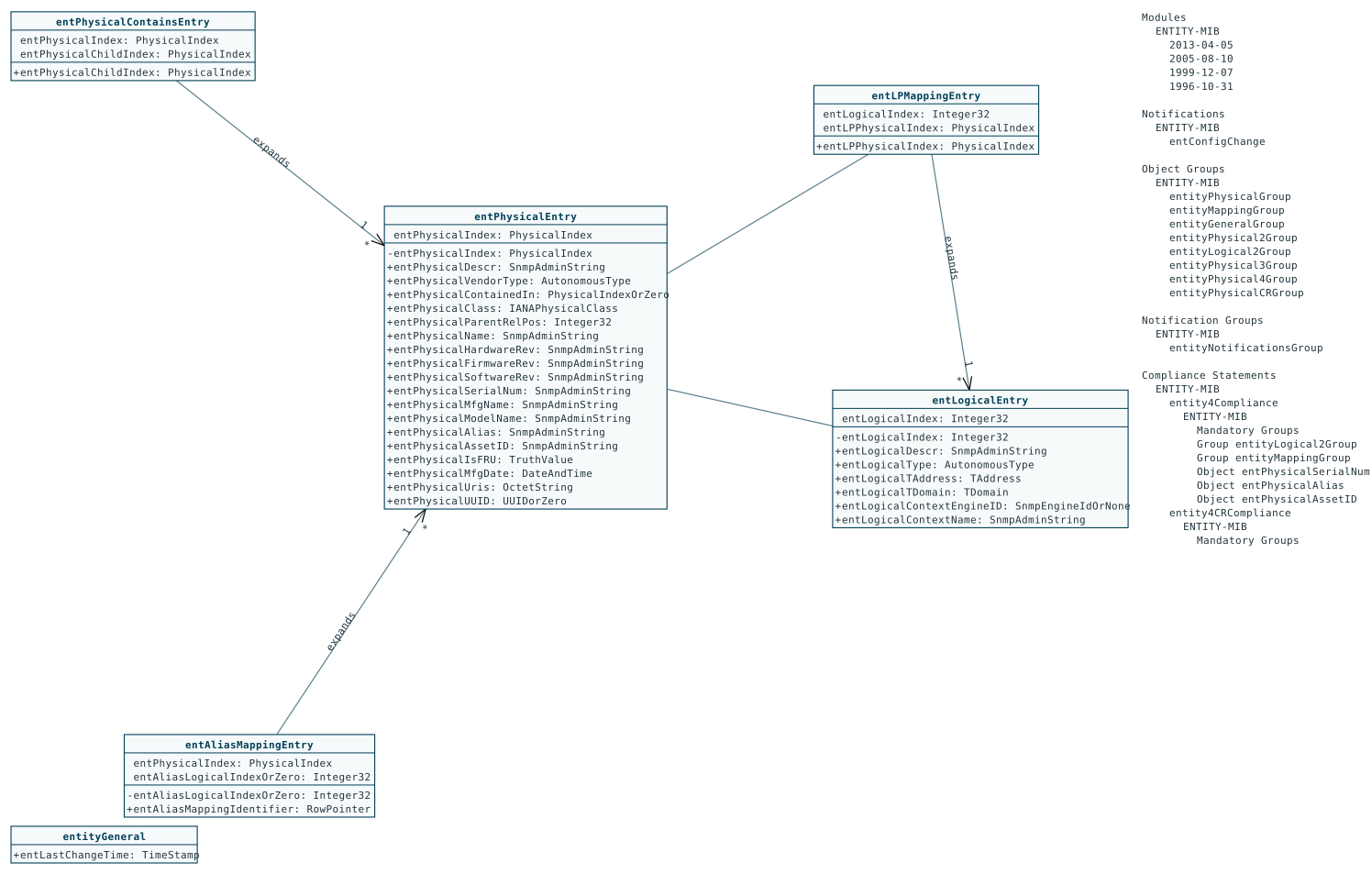
UML class diagram of the ENTITY-MIB: classes entPhysicalEntry, entLogicalEntry, entLPMappingEntry, entAliasMappingEntry, entPhysicalContainsEntry and entityGeneral with their index and columnar objects, connected by expands relationships; on the right the module's revisions, notifications, groups and compliance statements
smidump -f svg ENTITY-MIB (static output)

Background

In Reverse Engineering Internet MIBs, Jürgen Schönwälder and Andreas Müller developed an algorithm that extracts conceptual models from MIB modules. The algorithm is implemented in smidump as the output format cm, which produces XML files for the dia diagram editor. Klaus Sperner extended smidump by the format svg, which draws the same model as an SVG (Scalable Vector Graphics) diagram. Today, all web browsers display SVG directly.

The SVG diagrams, their layout and their interactivity (dragging classes, tooltips, highlighting of groups and compliances, folding of the module information) are the work of Klaus Sperner (2004–2005), based on the reverse engineering algorithm and the cm driver of Andreas Müller and Jürgen Schönwälder. In libsmi 0.6 (2026) the driver was fixed for descriptions with many special characters, and its links to a former CGI script were replaced by the option --svg-link-url; the web tools show his diagrams with a matching font, zooming and panning.

Reading a diagram

There is a UML class for each conceptual row definition of the modules:

  • The name of the class is the name of the row definition. With the interactive output, the small square on the left of the name is a handle to drag the class with the mouse, and the descriptions of the table and its entries appear when the mouse is over the name.
  • An optional second section shows the scalar objects associated with the class.
  • The next section lists the objects of the INDEX clause of the row.
  • The last section contains all columnar objects of the row; index objects defined in the same table appear in both sections.
  • Each entry shows the name of an object and its type, preceded by - if the object is not-accessible, else by +. Descriptions appear as tooltips. Objects in blue are defined in another module: in the web tools, clicking them draws the diagram again with that module added.

Scalar objects that are not bound to a conceptual row are grouped into additional classes. Besides unlabeled edges there are four kinds of labeled edges: augments, sparsely augments, reorders and expands, with cardinalities and arrowheads; their meaning is explained in the paper. Dashed edges are dependency relationships.

On the right, the diagram lists further information on the modules:

  • Modules – the modules with their revision history; descriptions appear as tooltips.
  • Notifications – the notification types; the objects of a notification are highlighted in the class diagram when the mouse is over it, a click keeps them highlighted.
  • Object Groups and Notification Groups – likewise for the groups.
  • Compliance Statements – for every statement the modules with their mandatory groups, groups and objects, with the same highlighting.

Command line

smidump writes the diagram to standard output. Use -u to draw several modules in one diagram:

$ smidump -f svg ENTITY-MIB > ENTITY-MIB.svg
$ smidump -u -f svg IF-MIB IP-MIB > interfaces.svg
$ smidump -f svg --svg-static-output --svg-show-deprecated IF-MIB > IF-MIB.svg
OptionMeaning
--svg-width=number, --svg-height=numbersize of the SVG canvas (default 1100 × 700)
--svg-show-deprecatedshow deprecated objects
--svg-show-depr-obsoleteshow deprecated and obsolete objects
--svg-static-outputno interactivity (no scripts), e.g. for printing or for documents
--svg-link-url=urllink objects and modules of other modules to url?…&mibs=A&mibs=B, a diagram that includes them (the web tools use diagram.php); without it there are no links

The web tools show the diagrams with a font that matches the box sizes computed by smidump, fit the view to the whole diagram, and add zooming and panning; the styled diagram can be downloaded as static SVG or as PNG.


aktualisiert am 17.11.2026, 15:48 von Frank Steinberg

Für alle

Stellen der TU Braunschweig
Jobbörse des Career Service
Merchandising
Sponsoring- & Spendenleistungen
Drittmittelgeförderte Forschungsprojekte
Vertrauenspersonen für Hinweisgeber

Für Studierende

Semestertermine
Lehrveranstaltungen
Studiengänge von A-Z
Informationen für Erstsemester
TUCard

Interne Tools

Status GITZ-Dienste
Handbuch für TYPO3 (Intern)
Corporate Design-Toolbox (Intern)
Glossar (DE-EN)
Meine Daten ändern
Hochschulöffentliche Bekanntmachungen

Kontakt

Technische Universität Braunschweig
Universitätsplatz 2
38106 Braunschweig
Postfach: 38092 Braunschweig
Telefon: +49 (0) 531 391-0

Anreise

© Technische Universität Braunschweig
Impressum Datenschutz Barrierefreiheit