

The core of the libsmi distribution is a C library that allows management applications to access MIB, PIB and YANG module definitions. On top of this library, there are tools to check, analyze, dump, convert and compare module definitions. Finally, the distribution contains an archive of all IETF and IANA MIB, PIB and YANG modules.
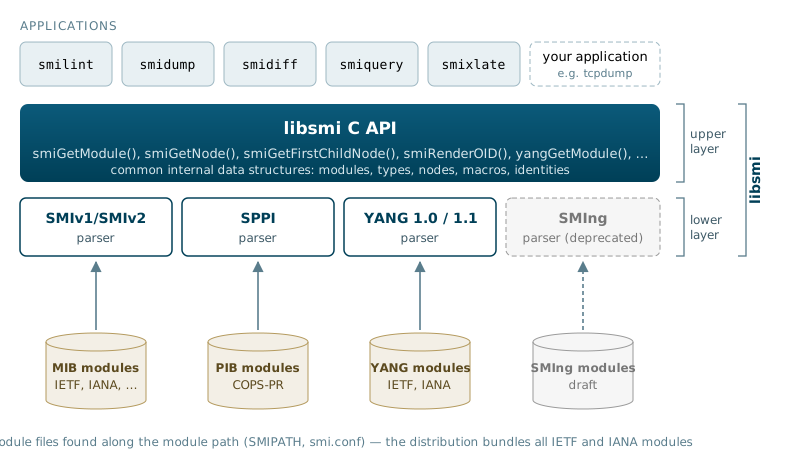
The library is internally divided into two layers. The upper layer is the API to applications that make use of libsmi; it holds the module information in common internal data structures. The lower layer contains the drivers that read module definitions from files: parsers for SMIv1/SMIv2 MIB modules, for SPPI PIB modules and for YANG 1.1 and YANG 1.0 modules. A parser for an early draft of SMIng is still present, but deprecated and disabled by default.
libsmi 0.6 is a modernization of the long-standing 0.4/0.5 code base, with the same API and ABI (the library remains libsmi.so.2):
The work on version 0.6 was done in mid November 2026 with the AI assistant Anthropic Claude, largely without human review of the individual changes. The changes are verified by the test suite, sanitizer runs and the CI pipeline and are documented in the NEWS file and in the git history. Please review them critically before relying on them.
libsmi is not actively maintained. Version 0.6 is the result of a one-time modernization effort. It is not the start of regular development, and there is no commitment to answer issues, review merge requests or publish further releases.
libsmi is used by network management software, for example by tcpdump to resolve object identifiers and named numbers in SNMP traffic, and it is packaged by most Linux distributions. Over the years, the GNOME SNMP manager GxSNMP, the MIB compiler of the DMH SNMP agent, MIB browsers and many in-house tools have used it.