

QuBRA was a collaborative research project focusing on the development and systematic benchmarking of quantum and classical methods for industrially relevant combinatorial optimization problems, especially in the fields of production, configuration, and logistics. The project was funded by the German Federal Ministry of Research, Technology and Space (BMFTR, formerly BMBF) from January 1, 2022, to June 30, 2025 within the initiative “Anwendungsnetzwerk für das Quantencomputing”. Leibniz University Hannover coordinated the consortium, and Technical University Braunschweig participated as a consortium partner.
Expectations regarding the capabilities of quantum computers suggest that quantum algorithms may be used to solve combinatorial optimization problems in the future. In practice, however, this depends on several factors, including the capabilities of quantum hardware, the structural characteristics of problem formulations, and the performance of competing classical solution approaches. Consequently, the goal of QuBRA was to comprehensively investigate the potential and limitations of quantum computing for practically relevant combinatorial optimization problems and to establish a reliable basis for evaluating quantum-based algorithms. To this end, QuBRA brought together an interdisciplinary consortium from the fields of quantum information, classical algorithms, machine learning, and software engineering in order to develop, implement, and systematically compare different deterministic and quantum-based algorithmic approaches.
Technical University Braunschweig participated in the project as a consortium partner and was particularly involved in the development and implementation of classical deterministic solution methods, as well as in the creation of benchmark instances and comparison methodologies.
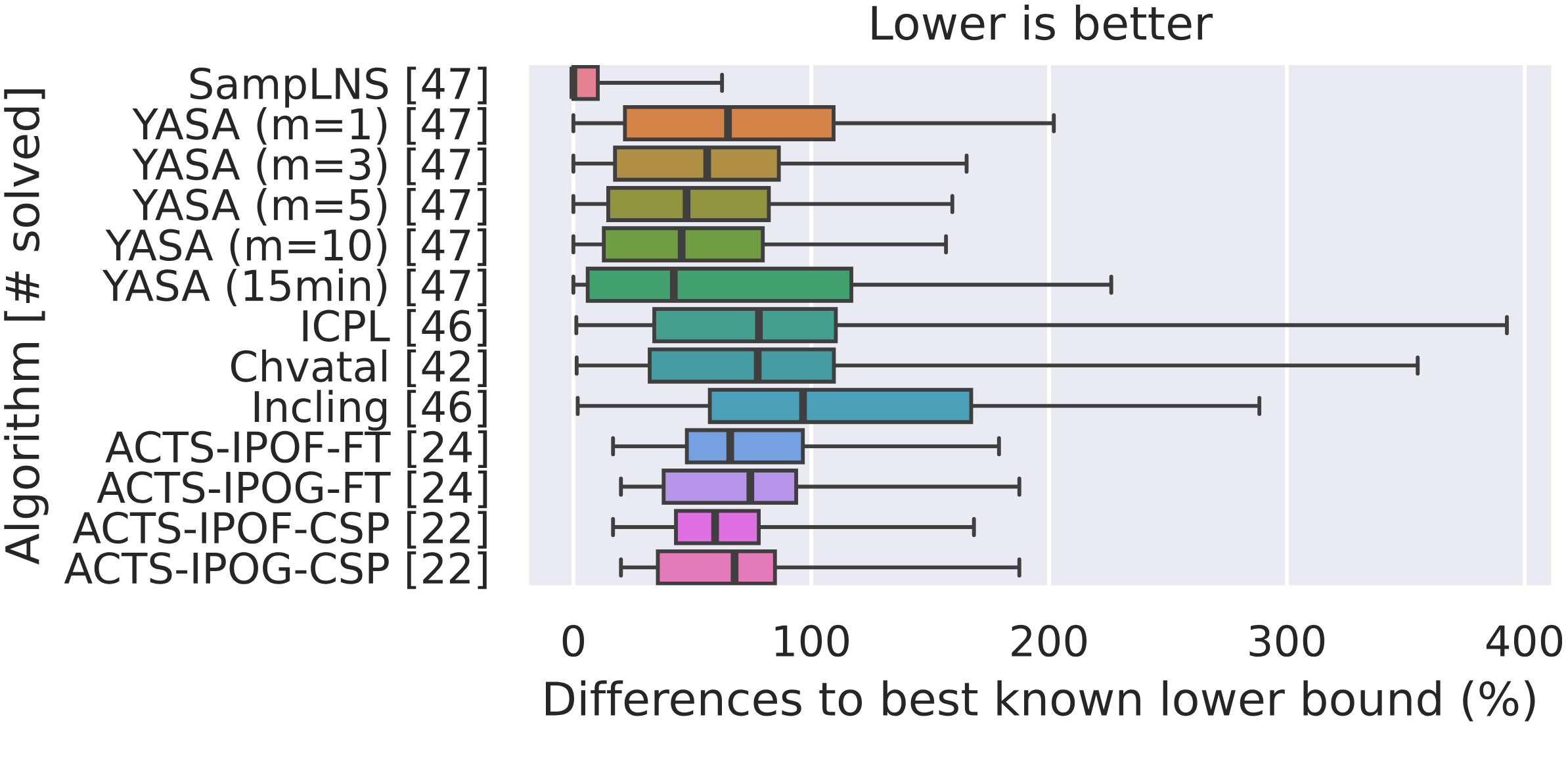
Within QuBRA, significant progress was achieved at Technical University Braunschweig in the development of classical optimization methods for configuration problems. In particular, the SampLNS algorithm by Krupke et al. introduced an approach capable of computing better solutions than previous methods while simultaneously determining mathematically rigorous lower bounds on the minimal solution size. This enabled, for the first time, a reliable assessment of the quality of a solution, and in many cases it was even possible to prove that the computed solutions are optimal.
These results were documented in the publication “How Low Can We Go? Minimizing Interaction Samples for Configurable Systems.” The findings presented in this work demonstrate that classical optimization methods continue to offer substantial potential for efficiently solving complex optimization problems.
Within the scope of the project, results were also achieved for optimization problems in the context of supply chain management and production planning. In this context, Technical University Braunschweig developed both classical and quantum-based solution methods for the analysis and solution of combinatorial optimization problems.
Furthermore, existing quantum-inspired approaches for structuring combinatorial search spaces were further developed and applied to various variants of the knapsack problem. In particular, this includes the Quantum Tree Generator, which was applied to the knapsack problem and later extended to the quadratic and multidimensional variant. Further information on this approach and the methods developed in the context of the knapsack problem is available on the ProvideQ project page.
The results achieved within the project show that classical optimization methods currently continue to outperform quantum-based approaches for many practically relevant combinatorial optimization problems. Their practical applicability is largely constrained by the currently limited capabilities of available quantum hardware.
Against this background, no direct marketable economic use of quantum-based optimization methods is expected in the short term. A broader practical application of quantum algorithms appears realistic only with future technological advances and depends in particular on further developments in quantum hardware. Nevertheless, the methods, benchmark instances, and analysis techniques developed within the project provide an important contribution to the systematic evaluation of quantum-based optimization approaches and establish a solid foundation for future research and potential applications as the technology matures.
The objective of this work package was the development of a benchmarking framework for the systematic and reproducible evaluation of the developed algorithmic approaches. For this purpose, a representative benchmark set was created to enable a direct comparison of classical, machine learning–based, and quantum-based methods.
These work packages focused on the investigation of several industrially motivated optimization problems, namely the configuration problem, job-shop scheduling, supply chain management, fleet management, and pickup-and-delivery in IoT environments. The goal was to evaluate the performance of different algorithmic approaches and, in particular, to investigate under which conditions quantum-based methods may offer a potential advantage over classical methods. To address these use cases, deterministic algorithms, machine learning methods, and quantum algorithms were developed.
This work package focused on the development of methods and tools for the structured development of quantum software. This particularly included the identification of reusable algorithmic concepts, the development of a standard library, and the investigation of suitable methods to ensure the correctness and reliability of quantum-based programs.
This work package covered the organizational coordination of the project consortium as well as the documentation and dissemination of the project results.
Leibniz University Hannover, under the leadership of Prof. Dr. Tobias J. Osborne from the Institute for Theoretical Physics, served as the consortium coordinator and was responsible for the coordination of the QuBRA project consortium. Leibniz University Hannover contributed to the scientific execution of the project and provided its expertise in the fields of quantum algorithms and combinatorial optimization.
Technical University Braunschweig participated in QuBRA as a consortium partner under the leadership of Prof. Dr. Sándor P. Fekete from the Algorithmics Group at the Institute of Operating Systems and Computer Networks and Prof. Dr. Ina Schaefer (then at the Institute of Software Engineering and Automotive Informatics). The work of the Algorithmics Group focused in particular on the development and evaluation of classical optimization methods as well as the provision of benchmark instances and comparison methodologies. In addition, the Institute of Software Engineering and Automotive Informatics contributed to the implementation of quantum algorithmic methods and participated in the development of methods and tools for quantum software engineering.
The University of Cologne participated in QuBRA as a consortium partner under the leadership of Prof. Dr. David Gross from the Institute for Theoretical Physics. His research focuses on quantum information theory, including the analysis, characterization, and simulation of quantum systems, as well as the development of mathematical methods for quantum computing.
Ruhr University Bochum participated in QuBRA as a consortium partner under the leadership of Prof. Dr. Michael Walter (then at the Faculty of Computer Science). His research focuses on quantum algorithms and quantum software as well as the development of innovative optimization algorithms for classical and quantum computers.
Infineon Technologies AG is a globally operating semiconductor manufacturer with headquarters in Germany and develops electronic systems and components for applications in the automotive industry, energy management, and digital security. Within QuBRA, Infineon contributed industrial use cases and requirements from semiconductor production and production planning.
Volkswagen AG is one of the world’s leading automotive manufacturers, with headquarters in Wolfsburg, and develops vehicles and mobility solutions for international markets. Within QuBRA, Volkswagen contributed industrial use cases from the areas of vehicle configuration and fleet management.
Prof. Dr. Tobias J. Osborne
Institute for Theoretical Physics
Leibniz University Hannover
Schneiderberg 32
30167 Hannover
Phone: +49 (0)511 762 17502
Email: tobias.osborne@itp.uni-hannover.de
Website: Prof. Dr. Tobias J. Osborne at LUH
Prof. Dr. Sándor P. Fekete
Algorithmics Group
Technical University Braunschweig
Mühlenpfordtstraße 23
38106 Braunschweig
Phone: +49 (0)531 391 311 1
Fax: +49 (0)531 391 310 9
Email: s.fekete@tu-bs.de
Website: Prof. Dr. Fekete at TU Braunschweig
Prof. Dr.-Ing. Ina Schaefer
Institute for Information Security and Dependability
Karlsruhe Institute got Technology
Am Fasanengarten 5
76131 Karlsruhe
Phone: +49 (0)721 9654-609
Email: ina.schaefer@kit.edu
Website: Prof. Dr.-Ing. Ina Schaefer at KIT