

ProvideQ was a collaborative research project focusing on the exploration and practical evaluation of quantum and hybrid algorithms for economically relevant optimization problems. The project was funded by the German Federal Ministry for Economic Affairs and Climate Action (BMWE, formerly BMWK) from January 1, 2022, to March 31, 2025 where the Technical University Braunschweig was the consortium leader.
The goal of ProvideQ was to systematically investigate the potential and limitations of quantum computing for economically relevant optimization problems and to identify practice-oriented application scenarios for the German industry. The project focused on the development, integration, and evaluation of quantum-based and hybrid algorithms for concrete industrial use cases, particularly in the areas of logistics and production. The results of the theoretical work were implemented in an open software platform, the ProvideQ Toolbox. Under the guiding principle “Enable the Enablers,” close collaboration with leading service providers ensured broad accessibility of the results.
The Karlsruhe Institute of Technology provides a publicly accessible version of the ProvideQ Toolbox.
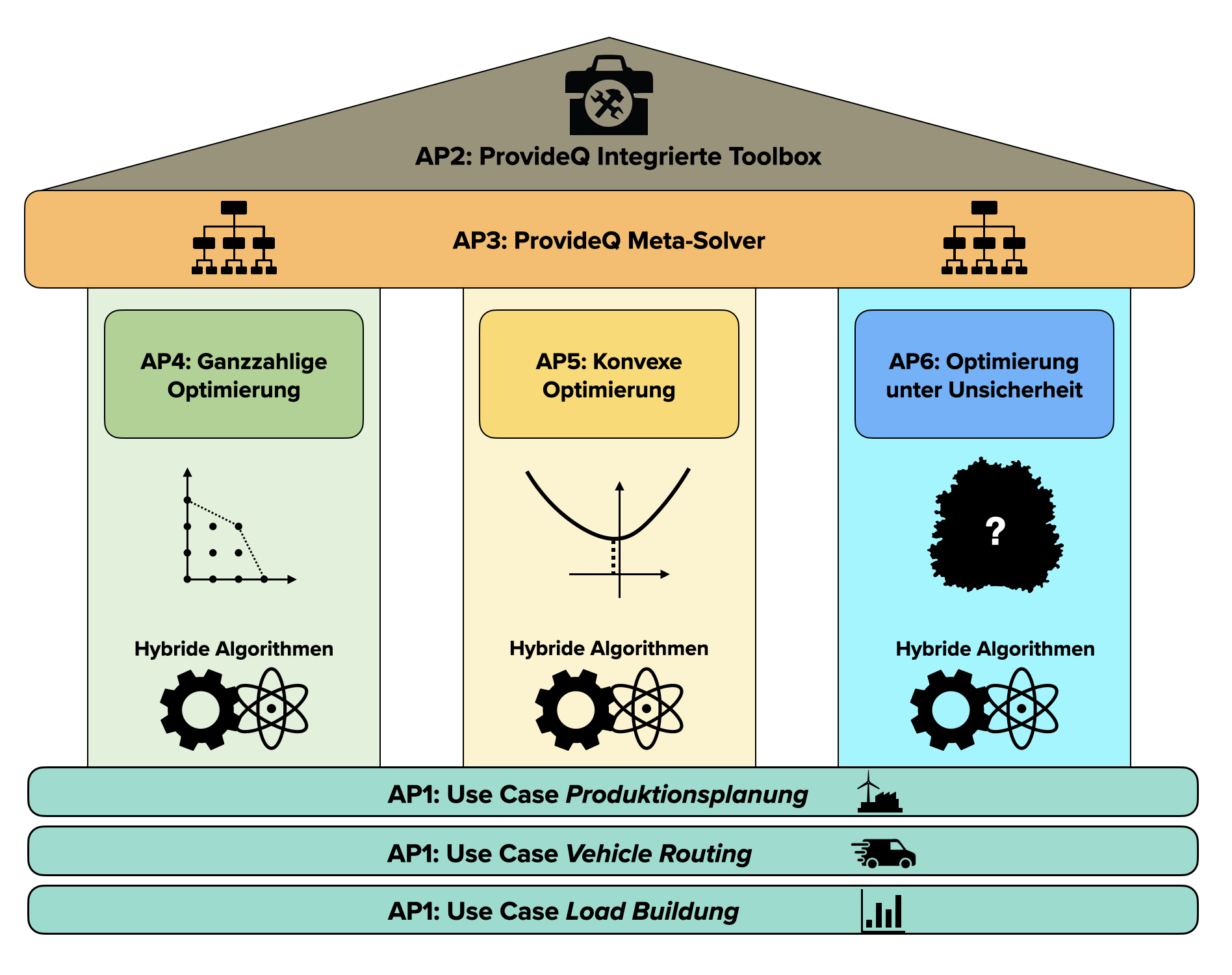
One of the central outcomes of ProvideQ was the development of the ProvideQ Toolbox as a modular integration platform for classical, quantum-based, and hybrid optimization methods. The goal of the toolbox was to provide a flexible environment in which different algorithmic approaches can be systematically combined and evaluated, supported by a plug-and-play concept that enables the seamless integration of solvers, algorithms, and subroutines.
A core component of the toolbox was a meta-solver logic that views optimization problems as an interplay of multiple subproblems. Depending on the problem structure, modeling approach, and solution requirements, classical solvers, quantum subroutines, or hybrid methods can be orchestrated accordingly. This polylithic approach allows for the combination of classical optimization techniques with experimental quantum methods. In particular, a hybrid meta-solving strategy was developed that successfully decomposes problems into subproblems, which are then addressed by the appropriate algorithmic approaches. Meta-solver strategies proved to be a suitable conceptual tool for realistically embedding quantum algorithms into existing optimization workflows.
ProvideQ was initially driven by three practice-relevant use cases from logistics and production planning, which served as benchmarks for evaluating the performance of quantum and hybrid algorithms compared to traditional solution methods. The considered scenarios included Load Building, the Vehicle Routing Problem, and Production Planning. These use cases were first formalized and equipped with realistic data sets. Over the course of the project, however, it became evident that the direct application of quantum-based and hybrid solution approaches to these complex problem settings is associated with significant challenges due to current limitations of quantum hardware and algorithms.
To nevertheless enable a sound evaluation of the developed methods, core problems were identified that reflect key structural properties of the original use cases. For Load Building, the focus was shifted to variants of the Knapsack Problem; for the Vehicle Routing Problem, an abstraction to the Traveling Salesman Problem was employed; and in the area of Production Planning, Job-Shop Scheduling was considered as a representative base problem. These core problems allowed the use of standardized benchmark instances and enabled systematic comparisons of classical and quantum-based methods under controlled conditions.
For integer optimization problems, various quantum-based and hybrid approaches were developed and investigated within ProvideQ. One key result was the development of Quantum Tree Generation (QTG), which delivered promising results particularly for variants of the well-known 0–1 Knapsack Problem and demonstrated that certain combinatorial subproblems can, in principle, benefit from quantum acceleration.
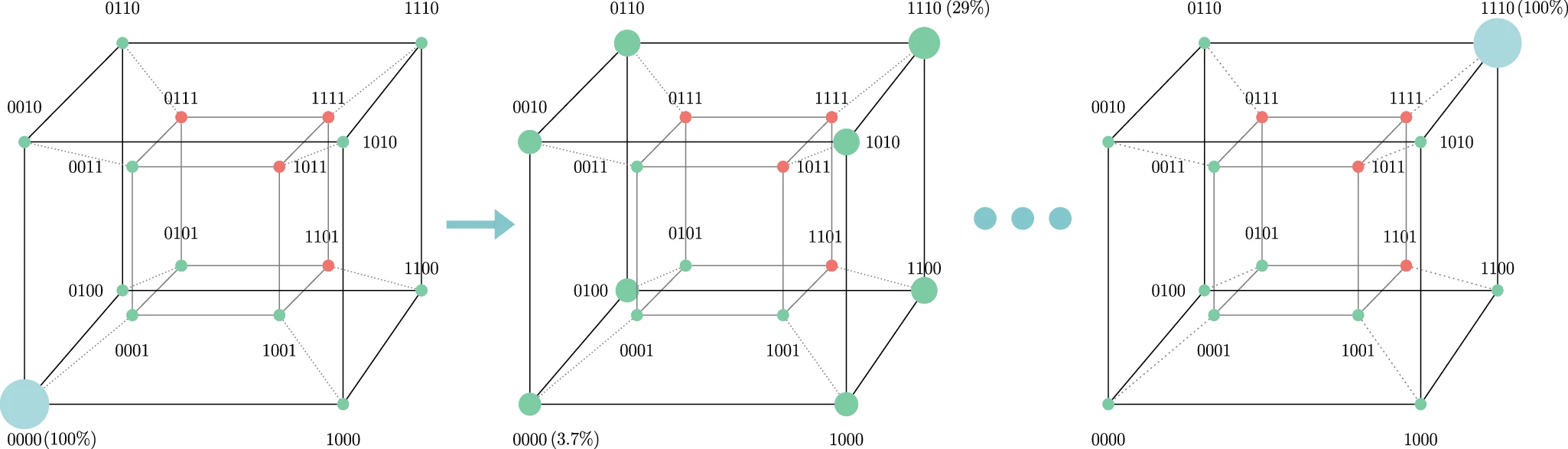
In addition, the Quantum Simplex algorithm was investigated in depth to obtain a realistic assessment of the competitiveness of quantum algorithms for integer optimization problems. The paper published in the context of ProvideQ demonstrated that the performance of quantum approaches is fundamentally constrained by structural properties and will therefore remain inferior to highly optimized classical algorithms even in the presence of significant advances in quantum hardware. At the same time, the Quantum Simplex algorithm provides a methodological foundation for systematically evaluating future quantum algorithms and embedding them into existing optimization workflows.
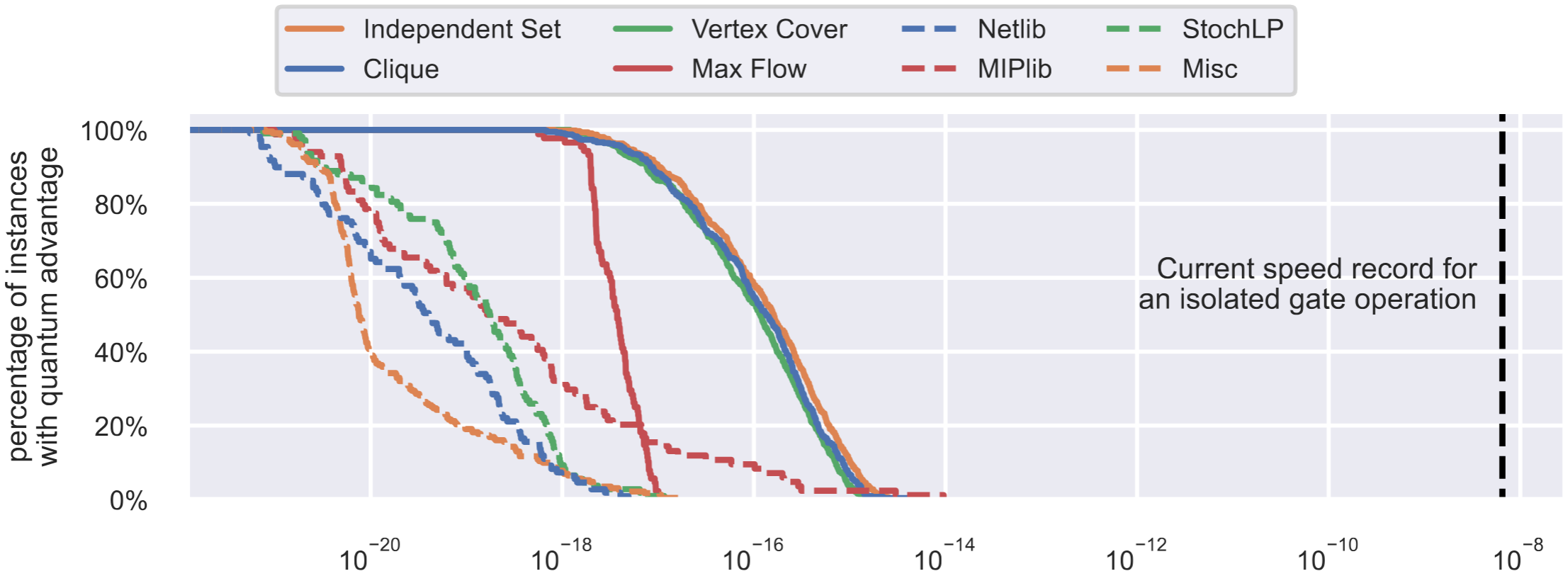
Overall, the results demonstrate that integer optimization poses particular challenges for quantum computing due to its discrete structure. While selected subproblems can be addressed using quantum methods, limitations in scalability remain, meaning that classical methods continue to outperform quantum approaches in realistic scenarios. Nevertheless, valuable insights were gained into how classical and quantum-based methods can be meaningfully combined.
For convex optimization problems, hybrid algorithmic methods were developed within ProvideQ. A central concept was the Hamiltonian Updates algorithm, which iteratively generates solution candidates by combining classical techniques with experimental quantum methods. In addition, a benchmarking framework was developed that compares classical and quantum-based Hamiltonian Updates algorithms on the use cases defined within ProvideQ.
The results show that classical approaches currently outperform quantum methods for practically relevant problem sizes, while quantum approaches primarily offer theoretical potential. The dominance of classical methods is mainly due to limitations of current quantum hardware and the complexity involved in translating real-world problems into quantum-compatible formulations.
For optimization problems under uncertainty, quantum-assisted methods were developed within ProvideQ, with a particular focus on network optimization and production planning.
A central result was the development of polyhedral models for the systematic sparsification of stochastic dependencies. These models enable the substantial simplification of large dependency graphs by exploiting suitable structural properties. Compared to existing approaches, this method proved to be significantly more efficient and allowed for a compact representation of robust optimization problems. In particular, the identification of suitable polyhedral structures turned out to be crucial for reducing problem complexity.
Another contribution was the development of the Multi-Objective Quantum Approximate Optimization Algorithm (MOQA). This approach extends existing quantum optimization techniques by enabling the consideration of multiple competing objective functions within a unified optimization framework. In contrast to previous heuristic approaches, MOQA is supported by theoretically grounded approximation guarantees, thereby opening new perspectives for the quantum-based treatment of binary optimization problems.
The objective of this work package was to ensure and assess the practical relevance of quantum-computing-based solutions for logistics optimization problems. To this end, three relevant use cases from different domains of practical logistics were identified in advance.
The goal of this work package was to design a modular and extensible software architecture for the ProvideQ Toolbox that integrates classical optimization methods and hybrid quantum algorithms within a unified system. The architecture was intended to connect different modeling systems, quantum SDKs, hardware platforms, and classical solvers, thereby enabling flexible solution strategies.
The objective of this work package was the development of polylithic meta-solvers that systematically combine classical optimization methods with quantum-based subroutines. These meta-solvers were designed to control hybrid solution strategies by determining where within a classical algorithm quantum methods should be applied. By extending the polylithic approach within GAMS, flexible, reusable, and formally verifiable integration of quantum algorithms into industrial optimization workflows was enabled.
This work package focused on extending integer optimization problems from industrial applications by incorporating quantum heuristics and quantum algorithms as subroutines. Three approaches were pursued: formulating problems as search problems to leverage quantum search algorithms, applying convex relaxations using linear quantum algebra, and employing quantum optimization heuristics for restricted subproblems.
Analogous to WP4, this work package aimed to address convex optimization problems arising from industrial applications and to investigate their solution using quantum algorithms and quantum heuristics. This included the analysis of specific convex problems originating from relaxations of non-convex combinatorial problems, as well as the preparation of existing quantum algorithmic approaches for integration into the ProvideQ Toolbox.
This work package aimed to develop a new method for incorporating uncertainty in network optimization problems subject to disruptions in logistics. A core aspect was the sparsification of large dependency graphs using a quantum algorithm.
The goal of this work package was to ensure effective collaboration within the ProvideQ consortium and to successfully disseminate project results to external stakeholders.
Technical University Braunschweig, led by Prof. Dr. Sándor Fekete, served as the consortium leader and held overall responsibility for the mathematical and algorithmic foundations of the toolbox. At the Institute of Algorithmics, the focus was on integrating mathematical methods, developing polylithic meta-solver strategies, and designing approaches for integer optimization. Prof. Dr. Fekete coordinated the project consortium and dissemination activities. The Institute for Mathematical Optimization, headed by Prof. Dr. Sebastian Stiller, worked on hybrid quantum algorithms for optimization under uncertainty, while the Institute for Analysis and Algebra, led by Prof. Dr. Timo de Wolff, developed hybrid quantum algorithms for convex optimization problems.
Karlsruhe Institute of Technology was responsible for the architectural design, implementation, and quality assurance of the ProvideQ Toolbox. Under the leadership of Prof. Dr. Ina Schaefer, KIT played a coordinating role between project partners and ensured that the methods developed in the three problem areas were consistently, maintainably, and industrially integrated into the toolbox.
The University of Köln contributed its expertise in quantum information theory and convex optimization to the project. Prof. Dr. David Gross was responsible for the analysis and development of hybrid quantum algorithms for convex optimization problems, in particular through the use of quantum-based subroutines. This work was carried out in close collaboration with Technical University Braunschweig and Johannes Kepler University Linz.
Leibniz University Hannover contributed its recognized expertise in quantum algorithm design to ProvideQ. Prof. Dr. Tobias J. Osborne was responsible for developing hybrid quantum algorithms for integer optimization problems, working closely with Technical University Braunschweig and Johannes Kepler University Linz.
4flow AG was responsible for collecting and preparing real-world logistics optimization problems, as well as deriving economic requirements for the ProvideQ Toolbox. In addition, 4flow evaluated the developed quantum methods and the toolbox with respect to their economic applicability.
GAMS Software GmbH focused on the development of polylithic meta-solver strategies as the logical core of the ProvideQ Toolbox. Based on the quantum algorithms developed in the three problem areas, these strategies were derived, evaluated, and validated.
Johannes Kepler University Linz supported the ProvideQ project as a subcontractor under Technical University Braunschweig in the areas of quantum computing and convex optimization. Under the leadership of Assistant Professor Dr. Richard Küng, JKU Linz made significant contributions to the development and scientific evaluation of hybrid and quantum-assisted methods for various optimization classes.
Prof. Dr. Sándor P. Fekete
Algorithmics Group
Technical University Braunschweig
Mühlenpfordtstraße 23
38106 Braunschweig
Phone: +49 (0)531 391 311 1
Fax: +49 (0)531 391 310 9
Email: s.fekete[[at]]tu-bs.de
Website: Prof. Dr. Fekete at TU Braunschweig
Dr. Christian Rieck
Discrete Mathematics
University of Kassel
Heinrich-Plett-Str. 40
34132 Kassel
Phone: +49 561 804-4192
Email: christian.rieck[[at]]mathematik.uni-kassel.de
Website: Dr. Rieck at the University of Kassel
Tobias Wallner
Algorithmics Group
Technical University Braunschweig
Mühlenpfordtstraße 23
38106 Braunschweig
Phone: +49 (0)531 391 311 6
Email: wallner[[at]]ibr.cs.tu-bs.de
Website: Wallner at TU Braunschweig