
Technische Universität Braunschweig
  • Study & Teaching
    • Beginning your Studies
      • Prospective Students
      • Degree Programmes
      • Application
      • Fit4TU
      • Why Braunschweig?
    • During your Studies
      • Fresher's Hub
      • Term Dates
      • Courses
      • Practical Information
      • Beratungsnavi
      • Additional Qualifications
      • Financing and Costs
      • Special Circumstances
      • Health and Well-being
      • Campus life
    • At the End of your Studies
      • Discontinuation and Credentials Certification
      • After graduation
      • Alumni*ae
    • For Teaching Staff
      • Strategy, Offers and Information
      • Learning Management System Stud.IP
    • Contact
      • Study Service Centre
      • Academic Advice Service
      • Student Office
      • Career Service
  • Research
    • Research Profile
      • Core Research Areas
      • Clusters of Excellence at TU Braunschweig
      • Research Projects
      • Research Centres
      • Professors‘ Research Profiles
    • Early Career Researchers
      • Support in the early stages of an academic career
      • PhD-Students
      • Postdocs
      • Junior research group leaders
      • Junior Professorship and Tenure-Track
      • Habilitation
      • Service Offers for Scientists
    • Research Data & Transparency
      • Transparency in Research
      • Research Data
      • Open Access Strategy
      • Digital Research Announcement
    • Research Funding
      • Research Funding Network
      • Research funding
    • Contact
      • Research Services
      • Academy for Graduates
  • International
    • International Students
      • Why Braunschweig?
      • Degree seeking students
      • Exchange Studies
      • TU Braunschweig Summer School
      • Refugees
      • International Student Support
    • Going Abroad
      • Studying abroad
      • Internships abroad
      • Teaching and research abroad
      • Working abroad
    • International Researchers
      • Welcome Support
      • PhD Studies
      • Service for host institutes
    • Language and intercultural competence training
      • Learning German
      • Learning Foreign Languages
      • Intercultural Communication
    • International Profile
      • Internationalisation
      • International Cooperations
      • Strategic Partnerships
      • International networks
    • International House
      • About us
      • Contact & Office Hours
      • News and Events
      • International Days
      • 5th Student Conference: Internationalisation of Higher Education
      • Newsletter, Podcast & Videos
      • Job Advertisements
  • TU Braunschweig
    • Our Profile
      • Aims & Values
      • Regulations and Guidelines
      • Alliances & Partners
      • The University Development Initiative 2030
      • Foundation University
      • Facts & Figures
      • Our History
    • Career
      • Working at TU Braunschweig
      • Vacancies
    • Economy & Business
      • Entrepreneurship
      • Friends & Supporters
    • General Public
      • Check-in for Students
      • The Student House
      • Access to the University Library
    • Media Services
      • Communications and Press Service
      • Services for media
      • Film and photo permits
      • Advices for scientists
      • Topics and stories
    • Contact
      • General Contact
      • Getting here
  • Organisation
    • Presidency & Administration
      • Executive Board
      • Designated Offices
      • Administration
      • Committees
    • Faculties
      • Carl-Friedrich-Gauß-Fakultät
      • Faculty of Life Sciences
      • Faculty of Architecture, Civil Engineering and Environmental Sciences
      • Faculty of Mechanical Engineering
      • Faculty of Electrical Engineering, Information Technology, Physics
      • Faculty of Humanities and Education
    • Institutes
      • Institutes from A to Z
    • Facilities
      • University Library
      • Gauß-IT-Zentrum
      • Professional and Personnel Development
      • International House
      • The Project House of the TU Braunschweig
      • Transfer Service
      • University Sports Center
      • Facilities from A to Z
    • Equal Opportunity Office
      • Equal Opportunity Office
      • Family
      • Diversity for Students
  • Search
  • Quicklinks
    • People Search
    • Webmail
    • cloud.TU Braunschweig
    • Messenger
    • Cafeteria
    • Courses
    • Stud.IP
    • Library Catalogue
    • IT Services
    • Information Portal (employees)
    • Link Collection
    • DE
    • EN
    • IBR YouTube
    • Facebook
    • Instagram
    • YouTube
    • LinkedIn
    • Mastodon
Menu
  • Organisation
  • Faculties
  • Carl-Friedrich-Gauß-Fakultät
  • Institutes
  • Institute of Operating Systems and Computer Networks
  • Open Theses
Logo IBR
IBR Login
  • Institute of Operating Systems and Computer Networks
    • News
    • About us
      • Whole Team
      • Directions
      • Floor Plan
      • Projects
      • Publications
      • Software
      • News Archive
    • Connected and Mobile Systems
      • Team
      • Courses
      • Theses & Jobs
      • Projects
      • Publications
      • Software
      • Datasets
    • Reliable System Software
      • Overview
      • Team
      • Teaching
      • Theses & Jobs
      • Research
      • Publications
    • Algorithms
      • Team
      • Courses
      • Theses
      • Projects
      • Publications
    • Microprocessor Lab
    • Education
      • Summer 2026
      • Winter 2025/2026
      • Theses
    • Services
      • Library
      • Mailinglists
      • Webmail
      • Knowledge Base
      • Wiki
      • Account Management
      • Services Status
    • Spin-Offs
      • Docoloc
      • bliq (formerly AIPARK)
      • Confidential Technologies
    • Research Cooperations
      • IST.hub

A Time Synchronization Protocol for Wireless Body Sensor Networks

Student(visible for staff only)
SupervisorSana Saadaoui
ProfessorProf. Dr.-Ing. Lars Wolf
IBR GroupCM (Prof. Wolf)
TypeMaster Thesis, Diploma Thesis
Statuscancelled

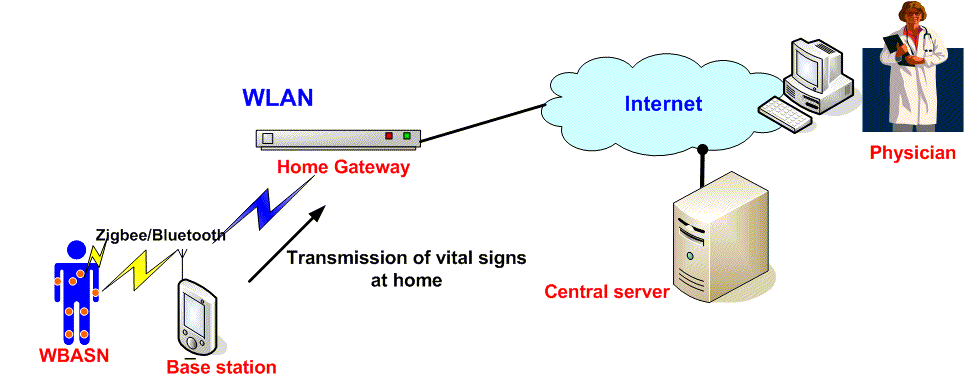
Overview: Patients suffering from chronic lung disease can follow a prescribed physical exercise at home to monitor their lungs during physical activity or ambulant rehabilitation. Equipped with a Wireless Body Area Sensor Network (WBASN), sensor nodes attached to the patient’s body sense, process and communicate vital signs to a base station. These sensors consist of an ECG sensor, activity sensors (accelerometers), a pulse oximeter, a blood pressure and a breathing rate sensor. The individual vital signs can be collected for a long period. Through the internet, a physician from his office can review the collected data and check the adherence of the patient to the program and his physiological response. He can also provide a feedback indicating whether actual physical strain is too low, right or overextending and suggest new prescribed physical exercises.

system architecture
Health monitoring system architecture

Time Synchronization is a crucial issue for such a WBASN. The detected events between sensors during a sampling interval need to be correlated. Applying a higher level multi-sensor data fusion provides a means to the physician to analyze the collected data. Hence, it is often necessary to fuse sensor values that occur at the same time. Time synchronization is also important to ensure accurate coordination of duty cycles and minimize energy consumption. The heterogeneous wireless sensors distributed on the body measure time using local clocks and have different sample frequencies. Local time readings of sensors can easily mismatch because of random phase shifts and drift rates of clock oscillators. The error is cumulative as the sensors operate for long periods and they can loose synchronization if we do not address this issue by a time synchronization protocol.

Project: This project is in collaboration with Peter L. Reichertz Institute for Medical Informatics. The goal of this thesis is to implement a time synchronization protocol for this WBASN scenario. The basic task of the student is to investigate current synchronization algorithms used in common Wireless Sensor Networks and to determine a suitable algorithm that can be used in the context of this medical application. Afterwards this algorithm has to be implemented and evaluated. The performance of the algorithm has to be analyzed in terms of the energy consumption of the sensors and the synchronization delay error.

Prerequisites: To accomplish this task, the student should have:

  • Basic Knowledge of Wireless Networks
  • Good C/C++ programming skills

Supervisors: Sana Saadaoui(IBR) , Klaus-Hendrik Wolf (MI)


last changed 2015-12-11, 09:40 by Sana Saadaoui

For All Visitors

Vacancies of TU Braunschweig
Career Service' Job Exchange 
Merchandising

For Students

Term Dates
Courses
Degree Programmes
Information for Freshman
TUCard

Internal Tools

Glossary (GER-EN)
Change your Personal Data

Contact

Technische Universität Braunschweig
Universitätsplatz 2
38106 Braunschweig

P. O. Box: 38092 Braunschweig
GERMANY

Phone: +49 (0) 531 391-0

Getting here

© Technische Universität Braunschweig
Imprint Privacy Accessibility