

Technische Universität Braunschweig
  • Study & Teaching
    • Beginning your Studies
      • Prospective Students
      • Degree Programmes
      • Application
      • Fit4TU
      • Why Braunschweig?
    • During your Studies
      • Fresher's Hub
      • Term Dates
      • Courses
      • Practical Information
      • Beratungsnavi
      • Additional Qualifications
      • Financing and Costs
      • Special Circumstances
      • Health and Well-being
      • Campus life
    • At the End of your Studies
      • Discontinuation and Credentials Certification
      • After graduation
      • Alumni*ae
    • For Teaching Staff
      • Strategy, Offers and Information
      • Learning Management System Stud.IP
    • Contact
      • Study Service Centre
      • Academic Advice Service
      • Student Office
      • Career Service
  • Research
    • Research Profile
      • Core Research Areas
      • Clusters of Excellence at TU Braunschweig
      • Research Projects
      • Research Centres
      • Professors‘ Research Profiles
    • Early Career Researchers
      • Support in the early stages of an academic career
      • PhD-Students
      • Postdocs
      • Junior research group leaders
      • Junior Professorship and Tenure-Track
      • Habilitation
      • Service Offers for Scientists
    • Research Data & Transparency
      • Transparency in Research
      • Research Data
      • Open Access Strategy
      • Digital Research Announcement
    • Research Funding
      • Research Funding Network
      • Research funding
    • Contact
      • Research Services
      • Academy for Graduates
  • International
    • International Students
      • Why Braunschweig?
      • Degree seeking students
      • Exchange Studies
      • TU Braunschweig Summer School
      • Refugees
      • International Student Support
    • Going Abroad
      • Studying abroad
      • Internships abroad
      • Teaching and research abroad
      • Working abroad
    • International Researchers
      • Welcome Support
      • PhD Studies
      • Service for host institutes
    • Language and intercultural competence training
      • Learning German
      • Learning Foreign Languages
      • Intercultural Communication
    • International Profile
      • Internationalisation
      • International Cooperations
      • Strategic Partnerships
      • International networks
    • International House
      • About us
      • Contact & Office Hours
      • News and Events
      • International Days
      • 5th Student Conference: Internationalisation of Higher Education
      • Newsletter, Podcast & Videos
      • Job Advertisements
  • TU Braunschweig
    • Our Profile
      • Aims & Values
      • Regulations and Guidelines
      • Alliances & Partners
      • The University Development Initiative 2030
      • Foundation University
      • Facts & Figures
      • Our History
    • Career
      • Working at TU Braunschweig
      • Vacancies
    • Economy & Business
      • Entrepreneurship
      • Friends & Supporters
    • General Public
      • Check-in for Students
      • The Student House
      • Access to the University Library
    • Media Services
      • Communications and Press Service
      • Services for media
      • Film and photo permits
      • Advices for scientists
      • Topics and stories
    • Contact
      • General Contact
      • Getting here
  • Organisation
    • Presidency & Administration
      • Executive Board
      • Designated Offices
      • Administration
      • Committees
    • Faculties
      • Carl-Friedrich-Gauß-Fakultät
      • Faculty of Life Sciences
      • Faculty of Architecture, Civil Engineering and Environmental Sciences
      • Faculty of Mechanical Engineering
      • Faculty of Electrical Engineering, Information Technology, Physics
      • Faculty of Humanities and Education
    • Institutes
      • Institutes from A to Z
    • Facilities
      • University Library
      • Gauß-IT-Zentrum
      • Professional and Personnel Development
      • International House
      • The Project House of the TU Braunschweig
      • Transfer Service
      • University Sports Center
      • Facilities from A to Z
    • Equal Opportunity Office
      • Equal Opportunity Office
      • Family
      • Diversity for Students
  • Search
  • Quicklinks
    • People Search
    • Webmail
    • cloud.TU Braunschweig
    • Messenger
    • Cafeteria
    • Courses
    • Stud.IP
    • Library Catalogue
    • IT Services
    • Information Portal (employees)
    • Link Collection
    • DE
    • EN
    • IBR YouTube
    • Facebook
    • Instagram
    • YouTube
    • LinkedIn
    • Mastodon
Menu
  • Organisation
  • Faculties
  • Carl-Friedrich-Gauß-Fakultät
  • Institutes
  • Institute of Operating Systems and Computer Networks
  • Current Projects
  • SpaceAnts
Logo IBR
IBR Login
  • Institute of Operating Systems and Computer Networks
    • News
    • About us
      • Whole Team
      • Directions
      • Floor Plan
      • Projects
      • Publications
      • Software
      • News Archive
    • Connected and Mobile Systems
      • Team
      • Courses
      • Theses & Jobs
      • Projects
      • Publications
      • Software
      • Datasets
    • Reliable System Software
      • Overview
      • Team
      • Teaching
      • Theses & Jobs
      • Research
      • Publications
    • Algorithms
      • Team
      • Courses
      • Theses
      • Projects
      • Publications
    • Microprocessor Lab
    • Education
      • Summer 2026
      • Winter 2025/2026
      • Theses
    • Services
      • Library
      • Mailinglists
      • Webmail
      • Knowledge Base
      • Wiki
      • Account Management
      • Services Status
    • Spin-Offs
      • Docoloc
      • bliq (formerly AIPARK)
      • Confidential Technologies
    • Research Cooperations
      • IST.hub

SpaceAnts - Algorithmic Foundations for Constructing and Reconfiguring LargeScale Structures with Simple Robots

[This page is currently under construction and will be gradually supplemented.]

Overview

SpaceAnts is a research project investigating algorithmic foundations for the construction and reconfiguration of large-scale structures by simple autonomous robots. The project is led by the Technical University Braunschweig and carried out in collaboration with Bochum University of Applied Sciences, the University of Houston, the Stony Brook University, the MIT, and NASA. SpaceAnts has been funded by the German Research Foundation (DFG) since September 1, 2024 and is scheduled to run until August 31, 2027.

The central challenge of SpaceAnts is to enable a set of simple robots to solve complex construction tasks. In particular, the focus lies on constructions consisting of a large number of modular, lattice-based components. SpaceAnts aims to develop algorithmic foundations for the coordination of large swarms of simple robots without relying on individual robots with extensive capabilities. The project develops methods for optimization and coordination that take geometric aspects into account and are relevant for applications ranging from ultralight modular structures in space to microscopic environments.

Additional information about the project can be found on the project page at L3S and the project page at Bochum University of Applied Sciences.

Current Research Directions

Since SpaceAnts is still in its ongoing funding phase, final research results cannot yet be presented. The project addresses a wide range of research questions from different areas. In the following, two of these research directions are presented as examples.

Coordinated Motion Planning

One research focus of SpaceAnts is coordinated motion planning for large numbers of autonomous robots. The goal is to compute how a set of robots moving simultaneously in a shared environment can reach their individual target positions without colliding with each other.

Example instance of a set of robots as a polyomino
Figure 1: Example instance of a set of robots represented as a two-dimensional polyomino. Each orange cell of the grid in (a) corresponds to a robot. The orange line marks the boundary of the polyomino. (b) shows the dual graph of the polyomino, where robots are represented as nodes and adjacent robots are connected by edges. (c) depicts a cut through a polyomino, dividing the set of robots into two parts along a separating line between two boundary points of the polyomino. (adapted from: Sándor P. Fekete, Ramin Kosfeld, Peter Kramer, Jonas Neutzner, Christian Rieck, and Christian Scheffer: Coordinated Motion Planning: Multi-Agent Path Finding in a Densely Packed, Bounded Domain).

This problem leads to various optimization objectives. For example, one objective is to plan robot movements such that all robots reach their target positions as quickly as possible. In this case, the total time until the last robot reaches its destination is minimized, also known as the makespan. Another objective is to minimize the total distance traveled by all robots combined.
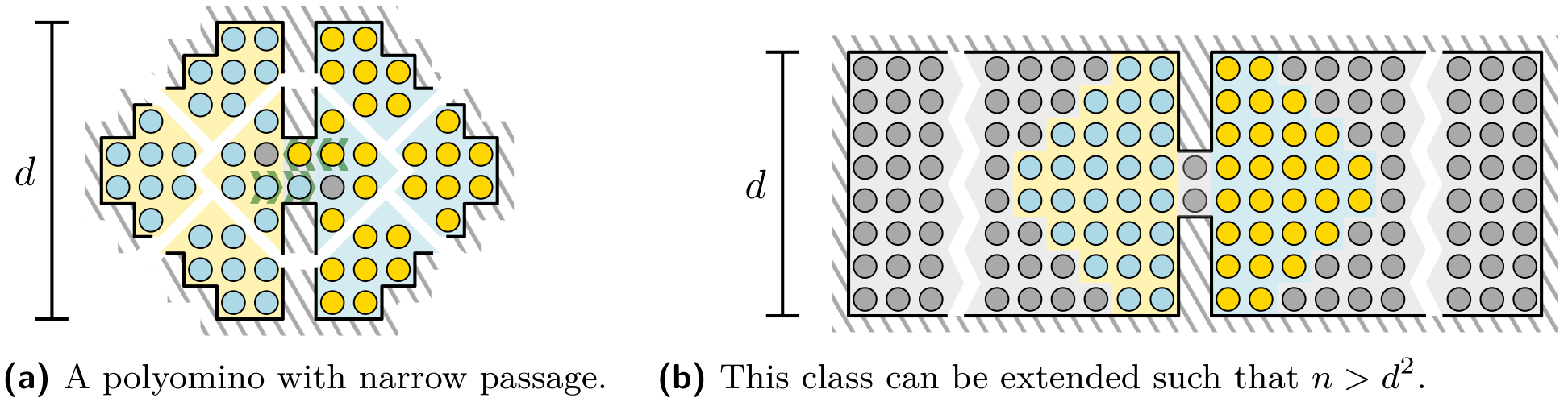
Example configuration with quadratic lower bound
Figure 2: Example instance of the Coordinated Motion Planning problem, where each motion plan with an optimal makespan has a runtime lower bound that grows quadratically with the diameter d. Due to the narrow passage, as shown in (a), only two robots can pass through simultaneously. This instance can be extended perpendicular to the diameter d, as illustrated in (b), resulting in an entire class of polyomino instances with this lower bound. (adapted from: Sándor P. Fekete, Ramin Kosfeld, Peter Kramer, Jonas Neutzner, Christian Rieck, and Christian Scheffer: Coordinated Motion Planning: Multi-Agent Path Finding in a Densely Packed, Bounded Domain).

Outlook

Building on previous results, SpaceAnts investigates how coordinated motion plans for large robot swarms can be further improved. One focus is the extension of existing two-dimensional approaches to three-dimensional scenarios in order to enable applications in real-world environments. Another objective is the analysis and improvement of the so-called stretch factor, which describes the ratio between the time required by a parallel motion plan and the theoretical minimum time. The stretch factor however is closely related to the spatial distribution of robots. SpaceAnts therefore aims to better understand the relationship between robot separation and the efficiency of parallel motion plans, to formalize the relationships between the relevant parameters, and to translate the developed algorithms into practical control protocols.

Reconfigurable Structures and Triangulations

A major bottleneck in efficient motion and reconfiguration planning can be the underlying structure on which these processes take place. In applications such as communication networks, logistics, or traffic control, this structure largely determines how efficiently information, materials, or robots can move. Therefore, it is not sufficient to optimize movements on a fixed structure; the structure itself should also be adapted and reconfigured to improve overall efficiency. An important model for such underlying structures are triangulations, i.e., planar connection structures that partition a set of points into triangles and thereby guarantee collision-free connections.
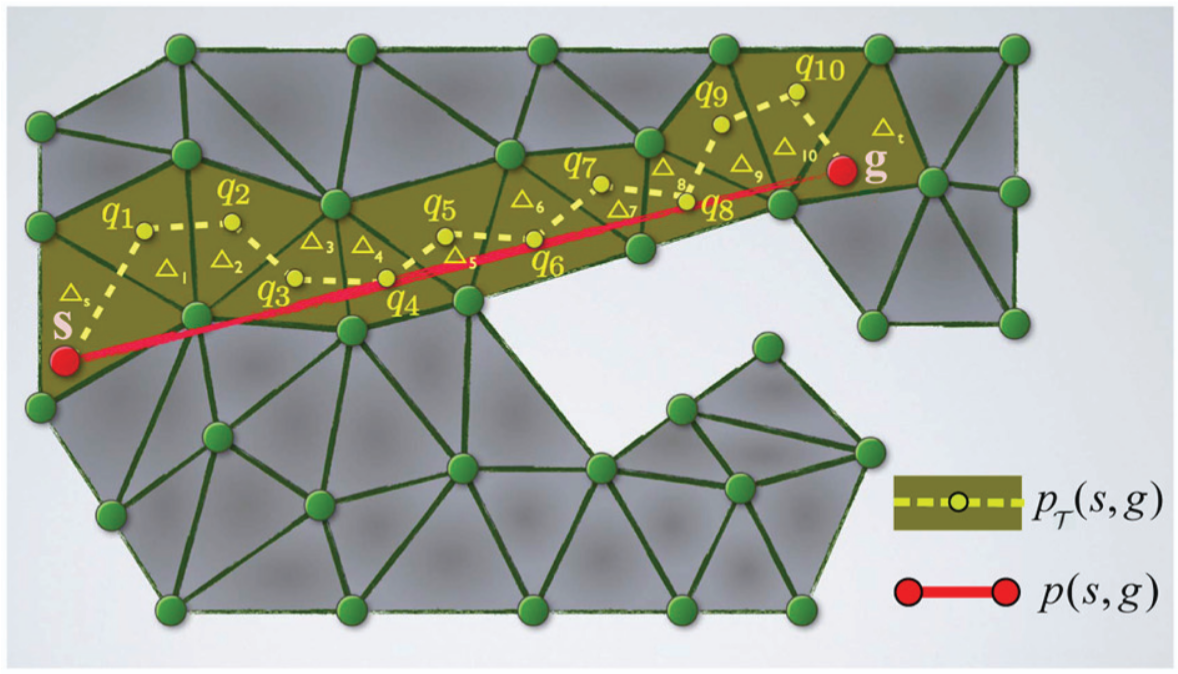
Triangulation created by robots with path
Figure 3: Triangulation of a region by a set of triangulation robots. Each robot is represented by a green point, and robots that can communicate with each other are connected by edges. The goal is to find a path connecting points s and g. While the red line represents the direct route between the two points, the yellow path runs along selected points within the triangulation. Each step of the yellow path crosses exactly one edge and therefore moves between adjacent triangles (adapted from: S. K. Lee, S. P. Fekete, and J. McLurkin: Structured triangulation in multi-robot systems: Coverage, patrolling, Voronoi partitions, and geodesic centers).

However, not all triangulations are equally suitable. Depending on how edges between points are chosen, the quality of the resulting structure can vary significantly. A central criterion is how efficient paths along the structure are compared to direct Euclidean connections.

Another focus of SpaceAnts is the reconfiguration of structures by robots with limited capabilities. The goal is to transform a given initial configuration into a desired target configuration by having individual robots perform local actions. The challenge lies in the fact that robots can only plan their actions based on local information. One example of this class of problems is the Tile Reconfiguration Problem, in which a single robot with the (limited) capabilities, e.g. those of a DFA, has to transform an initial tile configuration into a target configuration.
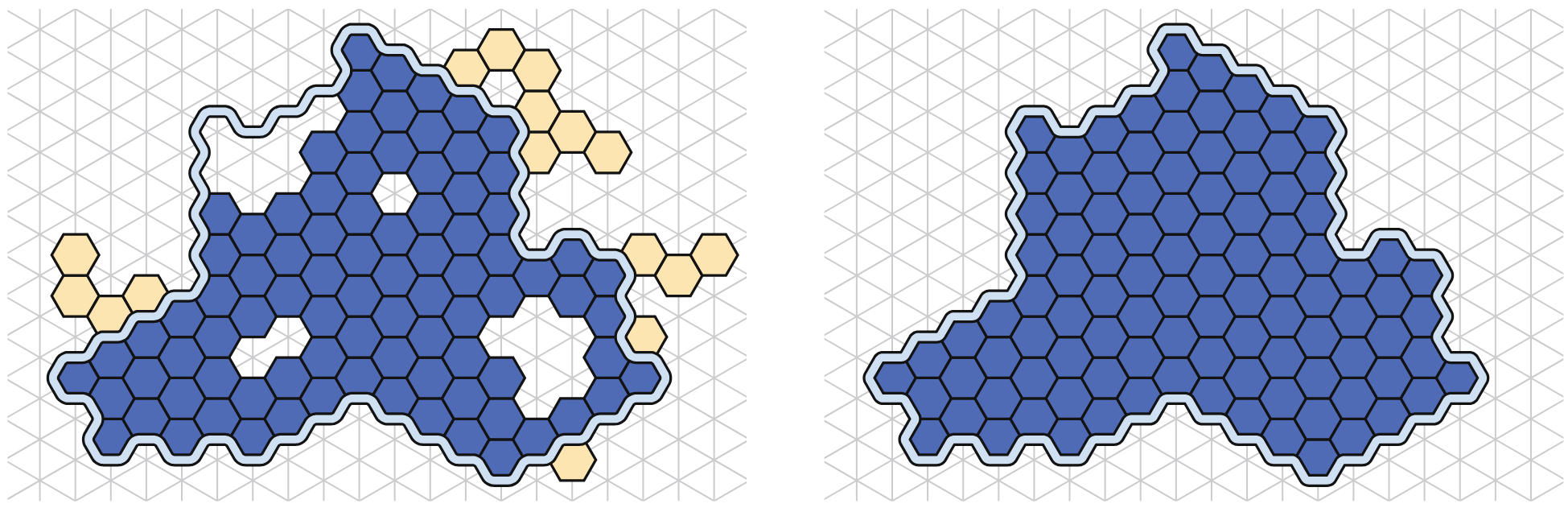
Example instance of the Tile Reconfiguration Problem
Figure 4: Example instance of the Tile Reconfiguration Problem. Blue tiles overlap with the target configuration, while yellow tiles are not part of the target configuration. The left image shows the initial configuration, while the right image shows the final configuration in which all previously misplaced tiles have been moved to their correct positions. Due to the limited capabilities of the robot, transferring misplaced tiles into the correct target configuration is non-trivial (taken from: Jonas Friemel, David Liedtke, and Christian Scheffer: Tile Reconfiguration by a Finite Automaton).

Outlook

Within SpaceAnts, the focus lies on the parallel reconfiguration of triangulations, in particular Delaunay triangulations and minimum-weight triangulations. The project investigates how local structural changes can be performed in parallel in order to reduce total reconfiguration time, and how these changes affect the quality of the resulting structure.

In addition, dynamically changing reconfiguration structures are considered, where the underlying structure changes while it is being used. In such scenarios, robots move along a structure that is simultaneously being reconfigured. This requires new algorithmic methods that consider reconfiguration and movement simultaneously and enable efficient paths in dynamically changing structures.

Further Research Topics

In addition to the research directions described above, the SpaceAnts project includes several further topics related to algorithmic and geometric foundations for robotic systems and reconfigurable structures. These include, among others:

  • Efficient assembly under Global ontrol
  • Algorithmic Mechanisms for Load Balancing in Robot Swarms
  • Reconfiguration of Structures by Robot Swarms
  • Facility Location and Supply Chain Management
  • Algorithms and Mechanisms for Robotic Platforms with Limited Capabilities
  • Simulation and Experimental Test Environments

Project Videos

In collaboration with the Technical University Braunschweig, two videos were produced for SpaceAnts that illustrate the research topics addressed.

Contact

Principal Investigator of Technical University Braunschweig


Prof. Dr. Sándor P. Fekete
Algorithmics Group
Technical University Braunschweig
Mühlenpfordtstraße 23
38106 Braunschweig
Phone: +49 (0)531 391 311 1
Fax: +49 (0)531 391 310 9
Email: s.fekete@tu-bs.de
Website: Prof. Dr. Fekete at TU Braunschweig


last changed 2026-04-08, 22:44 by Elias Kaiser

For All Visitors

Vacancies of TU Braunschweig
Career Service' Job Exchange 
Merchandising

For Students

Term Dates
Courses
Degree Programmes
Information for Freshman
TUCard

Internal Tools

Glossary (GER-EN)
Change your Personal Data

Contact

Technische Universität Braunschweig
Universitätsplatz 2
38106 Braunschweig

P. O. Box: 38092 Braunschweig
GERMANY

Phone: +49 (0) 531 391-0

Getting here

© Technische Universität Braunschweig
Imprint Privacy Accessibility