

Technische Universität Braunschweig
  • Study & Teaching
    • Beginning your Studies
      • Prospective Students
      • Degree Programmes
      • Application
      • Fit4TU
      • Why Braunschweig?
    • During your Studies
      • Fresher's Hub
      • Term Dates
      • Courses
      • Practical Information
      • Beratungsnavi
      • Additional Qualifications
      • Financing and Costs
      • Special Circumstances
      • Health and Well-being
      • Campus life
    • At the End of your Studies
      • Discontinuation and Credentials Certification
      • After graduation
      • Alumni*ae
    • For Teaching Staff
      • Strategy, Offers and Information
      • Learning Management System Stud.IP
    • Contact
      • Study Service Centre
      • Academic Advice Service
      • Student Office
      • Career Service
  • Research
    • Research Profile
      • Core Research Areas
      • Clusters of Excellence at TU Braunschweig
      • Research Projects
      • Research Centres
      • Professors‘ Research Profiles
    • Early Career Researchers
      • Support in the early stages of an academic career
      • PhD-Students
      • Postdocs
      • Junior research group leaders
      • Junior Professorship and Tenure-Track
      • Habilitation
      • Service Offers for Scientists
    • Research Data & Transparency
      • Transparency in Research
      • Research Data
      • Open Access Strategy
      • Digital Research Announcement
    • Research Funding
      • Research Funding Network
      • Research funding
    • Contact
      • Research Services
      • Academy for Graduates
  • International
    • International Students
      • Why Braunschweig?
      • Degree seeking students
      • Exchange Studies
      • TU Braunschweig Summer School
      • Refugees
      • International Student Support
    • Going Abroad
      • Studying abroad
      • Internships abroad
      • Teaching and research abroad
      • Working abroad
    • International Researchers
      • Welcome Support
      • PhD Studies
      • Service for host institutes
    • Language and intercultural competence training
      • Learning German
      • Learning Foreign Languages
      • Intercultural Communication
    • International Profile
      • Internationalisation
      • International Cooperations
      • Strategic Partnerships
      • International networks
    • International House
      • About us
      • Contact & Office Hours
      • News and Events
      • International Days
      • 5th Student Conference: Internationalisation of Higher Education
      • Newsletter, Podcast & Videos
      • Job Advertisements
  • TU Braunschweig
    • Our Profile
      • Aims & Values
      • Regulations and Guidelines
      • Alliances & Partners
      • The University Development Initiative 2030
      • Foundation University
      • Facts & Figures
      • Our History
    • Career
      • Working at TU Braunschweig
      • Vacancies
    • Economy & Business
      • Entrepreneurship
      • Friends & Supporters
    • General Public
      • Check-in for Students
      • The Student House
      • Access to the University Library
    • Media Services
      • Communications and Press Service
      • Services for media
      • Film and photo permits
      • Advices for scientists
      • Topics and stories
    • Contact
      • General Contact
      • Getting here
  • Organisation
    • Presidency & Administration
      • Executive Board
      • Designated Offices
      • Administration
      • Committees
    • Faculties
      • Carl-Friedrich-Gauß-Fakultät
      • Faculty of Life Sciences
      • Faculty of Architecture, Civil Engineering and Environmental Sciences
      • Faculty of Mechanical Engineering
      • Faculty of Electrical Engineering, Information Technology, Physics
      • Faculty of Humanities and Education
    • Institutes
      • Institutes from A to Z
    • Facilities
      • University Library
      • Gauß-IT-Zentrum
      • Professional and Personnel Development
      • International House
      • The Project House of the TU Braunschweig
      • Transfer Service
      • University Sports Center
      • Facilities from A to Z
    • Equal Opportunity Office
      • Equal Opportunity Office
      • Family
      • Diversity for Students
  • Search
  • Quicklinks
    • People Search
    • Webmail
    • cloud.TU Braunschweig
    • Messenger
    • Cafeteria
    • Courses
    • Stud.IP
    • Library Catalogue
    • IT Services
    • Information Portal (employees)
    • Link Collection
    • DE
    • EN
    • IBR YouTube
    • Facebook
    • Instagram
    • YouTube
    • LinkedIn
    • Mastodon
Menu
  • Organisation
  • Faculties
  • Carl-Friedrich-Gauß-Fakultät
  • Institutes
  • Institute of Operating Systems and Computer Networks
  • Current Projects
  • CG:SHOP2
Logo IBR
IBR Login
  • Institute of Operating Systems and Computer Networks
    • News
    • About us
      • Whole Team
      • Directions
      • Floor Plan
      • Projects
      • Publications
      • Software
      • News Archive
    • Connected and Mobile Systems
      • Team
      • Courses
      • Theses & Jobs
      • Projects
      • Publications
      • Software
      • Datasets
    • Reliable System Software
      • Overview
      • Team
      • Teaching
      • Theses & Jobs
      • Research
      • Publications
    • Algorithms
      • Team
      • Courses
      • Theses
      • Projects
      • Publications
    • Microprocessor Lab
    • Education
      • Summer 2026
      • Winter 2025/2026
      • Summer 2025
      • Theses
    • Services
      • Library
      • Mailinglists
      • Webmail
      • Knowledge Base
      • Wiki
      • Account Management
      • Services Status
    • Spin-Offs
      • Docoloc
      • bliq (formerly AIPARK)
      • Confidential Technologies
    • Research Cooperations
      • IST.hub

CG:SHOP2 - Solving Hard Optimization Problems

[This page is currently under construction and will be gradually supplemented.]

Overview

CG:SHOP is a research project dedicated to the development of new methods for challenging geometric optimization problems. Since 2020, the project has been led by the Technical University Braunschweig in collaboration with several international research partners, and the first funding phase has already been successfully completed. The project is currently continuing in its second funding phase supported by the German Research Foundation (DFG). The goal of the project is to combine theoretical approaches from computational geometry with practical methods from algorithm engineering in order to develop efficient algorithms for realistic problem sizes.

In addition to the original research objectives, the first funding phase also initiated the annual CG:SHOP Challenge, an international competition in which selected geometric optimization problems are provided and research teams develop and evaluate new algorithmic solution approaches. Further information about the CG:SHOP Challenge can be found on the official website.

Results of the first funding phase

Geometric Structure Problems

One research focus in the area of geometric structure problems addressed the polygonization of point sets. The task is to construct a simple polygon from a given set of points such that all points appear as vertices and certain optimization criteria are satisfied, for example maximizing (MAX-AREA) or minimizing (MIN-AREA) the enclosed area. S. P. Fekete et al. conducted a systematic study of different exact solution approaches for the MIN-AREA and MAX-AREA problem. In particular, two different integer optimization models, an edge-based formulation and a triangulation-based formulation, were developed and compared.
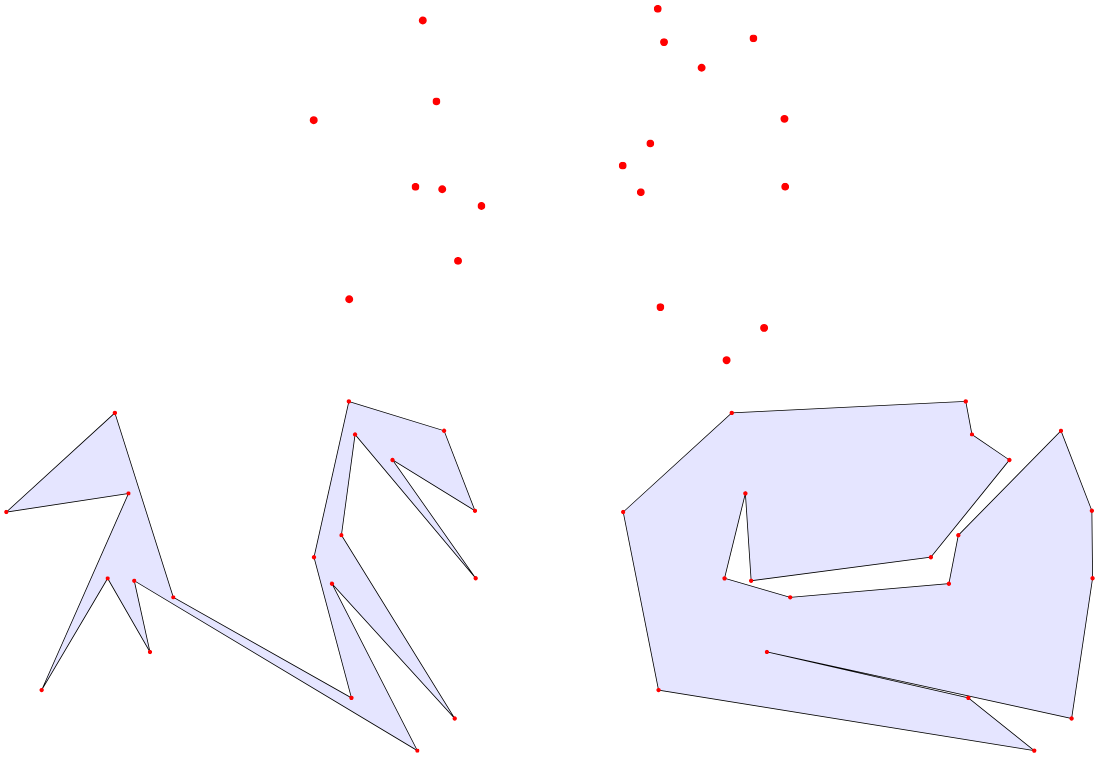
Example solutions for MIN-AREA and MAX-AREA
Figure 1: Example solutions for the two problem variants MIN-AREA and MAX-AREA for a point set of 20 points. The polygonal chains cannot be arbitrary. A chain forms a simple polygon if and only if no two edges intersect except at common endpoints (taken from: S. P. Fekete, J. S. B. Mitchell, C. Rieck, C. Scheffer, and C. Schmidt: Computing Area-Optimal Simple Polygonizations).

Using the improved formulations, S. P. Fekete et al. were able to solve a larger number of instances to optimality compared to previous approaches. Their results also demonstrate that polygonization problems such as MIN-AREA and MAX-AREA are practically more challenging than classical optimization problems such as the Euclidean Traveling Salesman Problem.
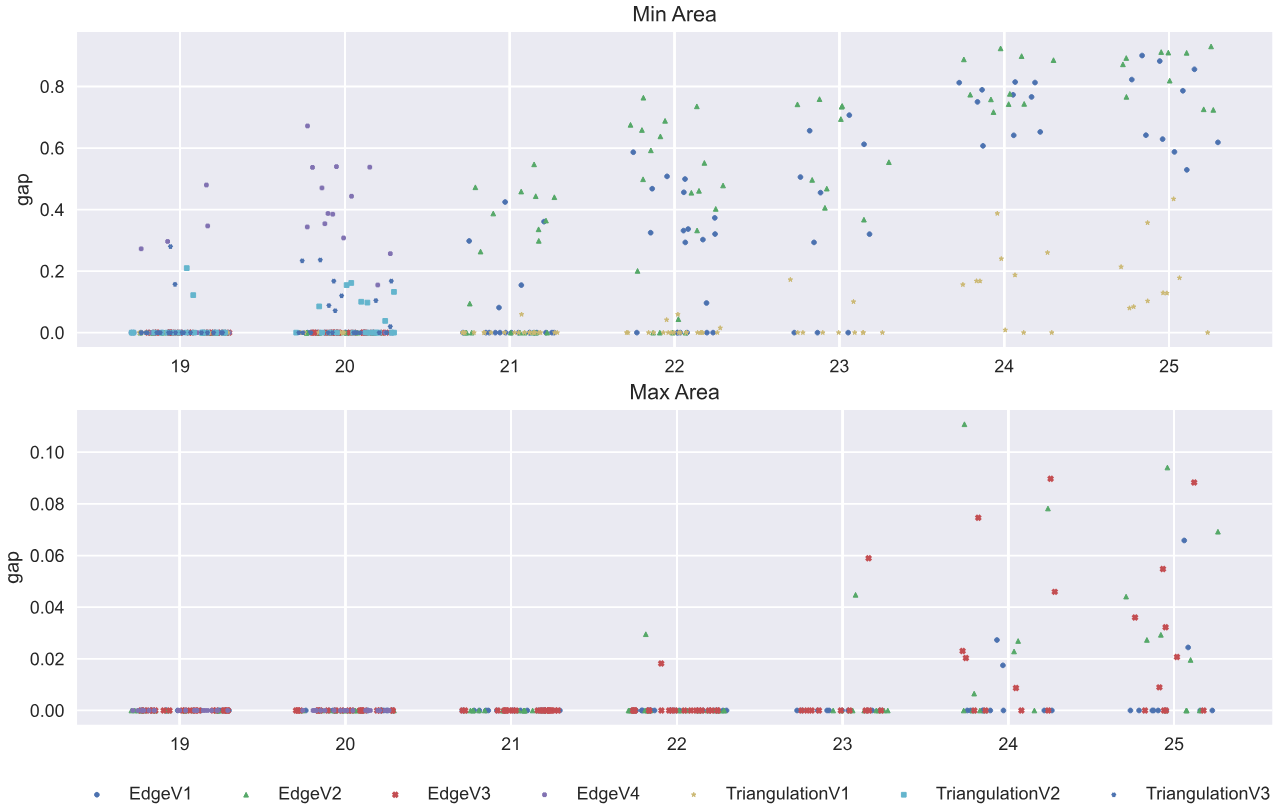
Optimality gaps of solution variants for MIN-AREA and MAX-AREA
Figure 2: Optimality gaps of the different variants of both formulations for the two problem variants MIN-AREA and MAX-AREA on instances with 19 to 25 points. An optimality gap describes the difference between the best solution found and the (possibly theoretical) optimal solution. It therefore measures how far the solution is from the optimum. The closer the optimality gap is to 0, the better the solution (taken from: S. P. Fekete, J. S. B. Mitchell, C. Rieck, C. Scheffer, and C. Schmidt: Computing Area-Optimal Simple Polygonizations).

Touring Problems

Another research focus in the area of touring problems concerned the Lawn Mowing Problem. In this problem, the goal is to compute a shortest closed tour for a region bounded by a polygon such that every point in this region lies within a given maximum distance from the tour. Intuitively, this can be understood as moving a disk with this maximum distance as its radius along the tour such that every point in the region is covered by the disk at least once. The problem generalizes several well-known geometric optimization problems and occurs in numerous practical applications, for example in robotics or manufacturing processes.
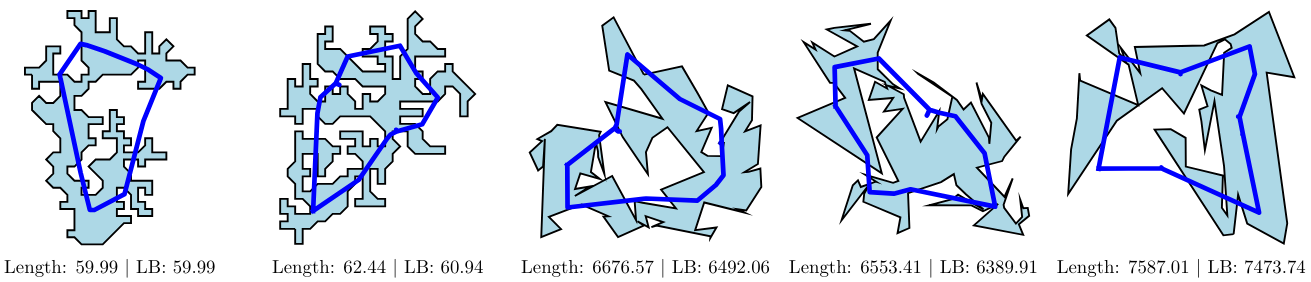
Feasible tours for different instances
Figure 3: Feasible tours for five different Lawn Mowing Problem instances. The light blue area marks the region that needs to be covered, while the blue line shows a tour that fully covers the region. The value below each solution on the left indicates the length of the computed tour, while the value on the right gives a (theoretical) lower bound for the length of a valid tour (taken from: S. P. Fekete, D. Krupke, M. Perk, C. Rieck, and C. Scheffer: A Closer Cut: Computing Near-Optimal Lawn Mowing Tours).

In their work on the Lawn Mowing Problem, which received the Best Paper Award at ALENEX 2023, S. P. Fekete et al. obtained significant results. They first showed that optimal tours always consist of a polygonal chain with finitely many vertices. This means that infinitely many points within the region to be covered can be represented by a finite set of vertices, which significantly restricts the solution space and forms the basis for algorithmic approaches.

In addition, they developed a primal-dual algorithm that iteratively extends an initial finite set of “witness points”. For these points, an approximate solution is computed by solving a Close-Enough TSP, thereby providing both an upper bound, meaning a feasible tour, and a lower bound for the optimal tour. Each iteration reduces the remaining optimality gap and thus enables provably near-optimal solutions for large instances.
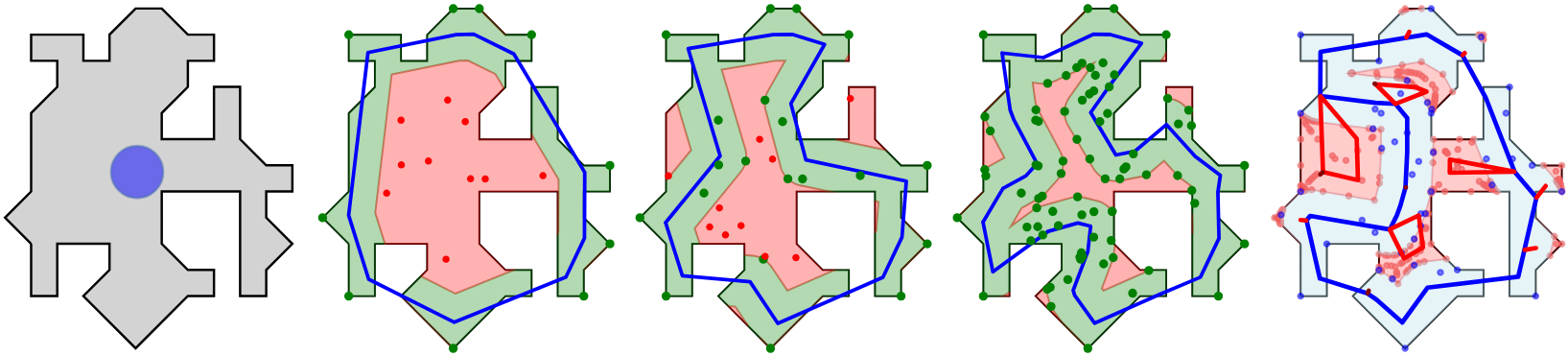
Visualization of the primal-dual algorithm using an example
Figure 4: Visualization of the primal-dual algorithm using a sample instance. (a) shows the instance including the disk cutter. (b)–(d) show the computed tour after the respective iterations over the currently considered witness points. The tour is computed from the dual problem, the Close-Enough TSP (CETSP) for the selected witness points. Green areas are covered by the tour, while red areas are not yet fully covered – this also includes witness points that are not reached in the current iteration. By iteratively adding further witness points and recomputing the CETSP tour, coverage is gradually improved. (e) shows the final tour that covers the entire region and therefore represents a feasible solution providing an upper bound (taken from: S. P. Fekete, D. Krupke, M. Perk, C. Rieck, and C. Scheffer: A Closer Cut: Computing Near-Optimal Lawn Mowing Tours).

Second funding phase -- CG:SHOP2

Building on the success of the first funding phase, CG:SHOP2 aims to develop new methods for computing provably optimal or near-optimal solutions for a broad class of geometric optimization problems. The project continues to investigate concrete problem classes from the first phase, including structure problems, touring problems, and packing problems, while simultaneously developing general algorithmic tools and analysis methods.

CG:SHOP Challenge

A particularly successful initiative that emerged from the first funding phase is the CG:SHOP Challenge, which has been held annually since 2019. This international competition focuses on a different challenging geometric optimization problem each year. Research teams as well as individual participants develop new algorithmic approaches and compare their methods on shared benchmark instances. The CG:SHOP Challenge combines theoretical questions from computational geometry with practical algorithmic techniques and realistic problem sizes.

The CG:SHOP Challenge has quickly developed into an important meeting point for the international research community. Through this open competition, new datasets, implementations, and algorithmic ideas are created, many of which lead to scientific publications. At the same time, the challenge provides a platform for early-career researchers to present their methods and compare them with established research teams.

Contact

Principal Investigator of Technical University Braunschweig


Prof. Dr. Sándor P. Fekete
Algorithmics Group
Technical University Braunschweig
Mühlenpfordtstraße 23
38106 Braunschweig
Phone: +49 (0)531 391 311 1
Fax: +49 (0)531 391 310 9
Email: s.fekete@tu-bs.de
Website: Prof. Dr. Fekete at TU Braunschweig


last changed 2026-03-15, 19:54 by Elias Kaiser

For All Visitors

Vacancies of TU Braunschweig
Career Service' Job Exchange 
Merchandising

For Students

Term Dates
Courses
Degree Programmes
Information for Freshman
TUCard

Internal Tools

Glossary (GER-EN)
Change your Personal Data

Contact

Technische Universität Braunschweig
Universitätsplatz 2
38106 Braunschweig

P. O. Box: 38092 Braunschweig
GERMANY

Phone: +49 (0) 531 391-0

Getting here

© Technische Universität Braunschweig
Imprint Privacy Accessibility