Technische Universität Braunschweig
  • Studium & Lehre
    • Vor dem Studium
      • Informationen für Studieninteressierte
      • Studiengänge von A-Z
      • Bewerbung
      • Fit4TU - Self-Assessment
      • Beratungsangebote für Studieninteressierte
      • Warum Braunschweig?
    • Im Studium
      • Erstsemester-Hub
      • Semestertermine
      • Lehrveranstaltungen
      • Studien-ABC
      • Studienorganisation
      • Beratungsnavi
      • Zusatzqualifikationen
      • Finanzierung und Kosten
      • Besondere Studienbedingungen
      • Gesundheit & Wohlbefinden
      • Campusleben
    • Nach dem Studium
      • Exmatrikulation und Vorlegalisation
      • Nach dem Abschluss
      • Alumni*ae
    • Strategien und Qualitätsmanagement
      • Strategiepapiere für Studium und Lehre
      • Studienqualitätsmittel
      • Studiengangsentwicklung
      • Qualitätsmanagement
      • Systemakkreditierung
      • Rechtliche Grundlagen
      • TU Lehrpreis
    • Für Lehrende
      • Informationen für Lehrende
      • Konzepte
      • Lernmanagementsystem Stud.IP
    • Kontakt
      • Studienservice-Center
      • Sag's uns - in Studium und Lehre
      • Zentrale Studienberatung
      • Immatrikulationsamt
      • Abteilung 16 - Studium und Lehre
      • Career Service
      • Projekthaus
  • Forschung
    • Forschungsprofil
      • Forschungsschwerpunkte
      • Exzellenzcluster der TU Braunschweig
      • Forschungsprojekte
      • Forschungszentren
      • Forschungsprofile der Professuren
    • Frühe Karrierephase
      • Förderung in den frühen Phasen der wissenschaftlichen Karriere
      • Promotion
      • Postdocs
      • Nachwuchsgruppenleitung
      • Junior Professur und Tenure-Track
      • Habilitation
      • Service-Angebote für Wissenschaftler*innen
    • Forschungsdaten & Transparenz
      • Transparenz in der Forschung
      • Forschungsdaten
      • Open Access Strategie
      • Digitale Forschungsanzeige
    • Forschungsförderung
      • Netzwerk Forschungsförderung
      • Datenbanken und Stiftungen
    • Kontakt
      • Forschungsservice
      • Graduiertenakademie
  • International
    • Internationale Studierende
      • Warum Braunschweig?
      • Studium mit Abschluss
      • Austauschstudium
      • TU Braunschweig Summer School
      • Geflüchtete
      • International Student Support
    • Wege ins Ausland
      • Studium im Ausland
      • Praktikum im Ausland
      • Lehren und Forschen im Ausland
      • Arbeiten im Ausland
    • Internationale Forschende
      • Welcome Support
      • Promotionsstudium
      • Service für gastgebende Einrichtungen
    • Sprachen und interkulturelle Kompetenzvermittlung
      • Deutsch lernen
      • Fremdsprachen lernen
      • Interkulturelle Kompetenzvermittlung
    • Internationales Profil
      • Internationalisierung
      • Internationale Kooperationen
      • Strategische Partnerschaften
      • Internationale Netzwerke
    • International House
      • Wir über uns
      • Kontakt & Sprechstunden
      • Aktuelles und Termine
      • International Days
      • 5. Studentische Konferenz: Internationalisierung der Hochschulen
      • Newsletter, Podcast & Videos
      • Stellenausschreibungen
  • Die TU Braunschweig
    • Unser Profil
      • Ziele & Werte
      • Ordnungen und Leitlinien
      • Allianzen & Partner
      • Hochschulentwicklung 2030
      • Stiftungsuniversität
      • Internationale Strategie
      • Fakten & Zahlen
      • Unsere Geschichte
    • Karriere
      • Arbeiten an der TU
      • Stellenmarkt
      • Berufsausbildung an der TU
    • Wirtschaft & Unternehmen
      • Unternehmensgründung
      • Freunde & Förderer
    • Öffentlichkeit
      • Veranstaltungskalender
      • Check-in für Schüler*innen
      • Hochschulinformationstag (HIT)
      • Kinder-Uni
      • Das Studierendenhaus
      • Gasthörer*innen & Senior*innenstudium
      • Nutzung der Universitätsbibliothek
    • Presse & Kommunikation
      • Stabsstelle Presse und Kommunikation
      • Medienservice
      • Ansprechpartner*innen
      • Tipps für Wissenschaftler*innen
      • Themen und Stories
    • Kontakt
      • Allgemeiner Kontakt
      • Anreise
      • Für Hinweisgeber
  • Struktur
    • Leitung & Verwaltung
      • Das Präsidium
      • Stabsstellen
      • Verwaltung
      • Organe, Statusgruppen und Kommissionen
    • Fakultäten
      • Carl-Friedrich-Gauß-Fakultät
      • Fakultät für Lebenswissenschaften
      • Fakultät Architektur, Bauingenieurwesen und Umweltwissenschaften
      • Fakultät für Maschinenbau
      • Fakultät für Elektrotechnik, Informationstechnik, Physik
      • Fakultät für Geistes- und Erziehungswissenschaften
    • Institute
      • Institute von A-Z
    • Einrichtungen
      • Universitätsbibliothek
      • Gauß-IT-Zentrum
      • Zentrale Personalentwicklung
      • International House
      • Projekthaus
      • Transferservice
      • Hochschulsportzentrum
      • Einrichtungen von A-Z
    • Studierendenschaft
      • Studierendenparlament
      • Fachschaften
      • Studentische Wahlen
    • Lehrer*innenbildung
      • Lehrer*innenfortbildung
      • Forschung
    • Chancengleichheit
      • Gleichstellung
      • Familie
      • Diversität
    • Kontakt
      • Personensuche
  • Suche
  • Schnellzugriff
    • Personensuche
    • Webmail
    • cloud.TU Braunschweig
    • Messenger
    • Mensa
    • TUconnect (Studierendenportal)
    • Lehrveranstaltungen
    • Im Notfall
    • Stud.IP
    • UB Katalog
    • Status GITZ-Dienste
    • Störungsmeldung GB3
    • IT Dienste
    • Informationsportal (Beschäftigte)
    • Beratungsnavi
    • Linksammlung
    • DE
    • EN
    • IBR YouTube
    • Facebook
    • Instagram
    • YouTube
    • LinkedIn
    • Mastodon
Menü
  • Struktur
  • Fakultäten
  • Carl-Friedrich-Gauß-Fakultät
  • Institute
  • Institut für Betriebssysteme und Rechnerverbund
  • Aktuelle Projekte
  • libsmi
Logo IBR
IBR Login
  • Institut für Betriebssysteme und Rechnerverbund
    • News
    • Wir über uns
      • Gesamtes Team
      • Anreise
      • Raumplan
      • Projekte
      • Veröffentlichungen
      • Software
      • News Archiv
    • Connected and Mobile Systems
      • Team
      • Lehrveranstaltungen
      • Abschlussarbeiten
      • Projekte
      • Veröffentlichungen
      • Software
      • Datensätze
    • Verlässliche Systemsoftware
      • Übersicht
      • Team
      • Lehre
      • Arbeiten & Jobs
      • Forschung
      • Publikationen
    • Algorithmik
      • Team
      • Lehrveranstaltungen
      • Abschlussarbeiten
      • Projekte
      • Veröffentlichungen
    • Mikroprozessorlabor
    • Studium
      • Wintersemester 2026/2027
      • Sommersemester 2026
      • Abschlussarbeiten
    • Service
      • Bibliothek
      • Mailinglisten
      • Webmail
      • Knowledgebase
      • Wiki
      • Account Management
      • Service-Status
    • Spin-Offs
      • Docoloc
      • bliq (formerly AIPARK)
      • Confidential Technologies
    • Forschungsverbünde
      • IST.hub

libsmi – a library to access SMI management information

The core of the libsmi distribution is a C library that allows management applications to access MIB, PIB and YANG module definitions. On top of this library, there are tools to check, analyze, dump, convert and compare module definitions. Finally, the distribution contains an archive of all IETF and IANA MIB, PIB and YANG modules.
Web toolsCheck, convert and draw modules online – no installation needed DownloadPackages for Linux, Windows and macOS, source code ModulesAll IETF and IANA MIB, PIB and YANG modules, bundled LibraryThe C API, data model and an example Toolssmilint, smidump, smidiff, smiquery, smixlate, smistrip DocumentationManual pages, papers and background
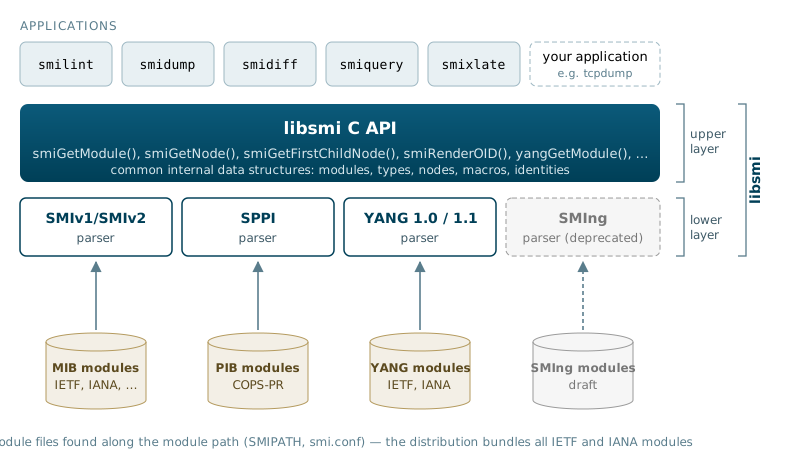
The layers of libsmi: applications on top of the libsmi C API and its internal data structures, below them parsers for SMIv1/SMIv2, SPPI, YANG and the deprecated SMIng, which read module files from the module path
The layered architecture of libsmi.

The library is internally divided into two layers. The upper layer is the API to applications that make use of libsmi; it holds the module information in common internal data structures. The lower layer contains the drivers that read module definitions from files: parsers for SMIv1/SMIv2 MIB modules, for SPPI PIB modules and for YANG 1.1 and YANG 1.0 modules. A parser for an early draft of SMIng is still present, but deprecated and disabled by default.

Version 0.6

libsmi 0.6 is a modernization of the long-standing 0.4/0.5 code base, with the same API and ABI (the library remains libsmi.so.2):

  • YANG 1.1 (RFC 7950) support, while YANG 1.0 modules are still read;
  • all MIB, PIB and YANG modules updated from the RFC Editor and the IANA (November 2026);
  • a modern autotools build, an alternative CMake build, and packages for Debian, Ubuntu, Fedora, RHEL/AlmaLinux, openSUSE, Windows and macOS;
  • many bug fixes found by static analysis, sanitizers and fuzzing, and an extended test suite run in continuous integration;
  • this web site, with new web tools.

The work on version 0.6 was done in mid November 2026 with the AI assistant Anthropic Claude, largely without human review of the individual changes. The changes are verified by the test suite, sanitizer runs and the CI pipeline and are documented in the NEWS file and in the git history. Please review them critically before relying on them.

Project status

libsmi is not actively maintained. Version 0.6 is the result of a one-time modernization effort. It is not the start of regular development, and there is no commitment to answer issues, review merge requests or publish further releases.

  • Everybody is free to continue the work in their own fork, under the terms of the license.
  • Maintainers of distribution packages are free to decide whether they adopt version 0.6 or stay with the previous code base (0.4.8/0.5).
  • The mailing list continues to exist for discussions among users and, if there is interest, among people who want to continue the development.

Users of libsmi

libsmi is used by network management software, for example by tcpdump to resolve object identifiers and named numbers in SNMP traffic, and it is packaged by most Linux distributions. Over the years, the GNOME SNMP manager GxSNMP, the MIB compiler of the DMH SNMP agent, MIB browsers and many in-house tools have used it.


aktualisiert am 17.11.2026, 15:48 von Frank Steinberg

Für alle

Stellen der TU Braunschweig
Jobbörse des Career Service
Merchandising
Sponsoring- & Spendenleistungen
Drittmittelgeförderte Forschungsprojekte
Vertrauenspersonen für Hinweisgeber

Für Studierende

Semestertermine
Lehrveranstaltungen
Studiengänge von A-Z
Informationen für Erstsemester
TUCard

Interne Tools

Status GITZ-Dienste
Handbuch für TYPO3 (Intern)
Corporate Design-Toolbox (Intern)
Glossar (DE-EN)
Meine Daten ändern
Hochschulöffentliche Bekanntmachungen

Kontakt

Technische Universität Braunschweig
Universitätsplatz 2
38106 Braunschweig
Postfach: 38092 Braunschweig
Telefon: +49 (0) 531 391-0

Anreise

© Technische Universität Braunschweig
Impressum Datenschutz Barrierefreiheit